

Sipho Mosai – CEO Rand Water
Rand Water CEO, Sipho Mosai Shares His Insight
Gauteng’s water supply and demand requirements need to be carefully managed in the current water scare and financially distressed municipal environment. The debate about water sufficiency cannot be isolated from a water quantity dialogue outside the affordability of a service that constitutes a basic human right, not only a social but also an economic one. The complexities of water provision must be fully understood in toto, beyond “just pump more water into the system,” to comprehend how provided water is efficiently utilised. To narrow and overly simplify it one-dimensional water science and is unsustainable. It can only serve to collapse the water supply system and annihilate the value chain, particularly Rand Water. This will result in in a never-seen-before water catastrophe in Gauteng and parts of Mpumalanga, North West and Free State Provinces.
SA is a Water Stressed Country
What we must first understand is that South Africa (SA) is a water stressed country with an annual rainfall around 492 mm against the global average of 985 mm. To make matters worse, rainfall distribution in the country is uneven with the western part of the country receiving over 1 000 mm of rainfall and the eastern receiving no more than 250 mm of rainfall. Gauteng only receives between 500-1 000mm, not sufficient to meet the water use needs of Gauteng; for irrigation, environmental, domestic, mining and industrial uses even if it was to be dammed.
To rub salt into the wound, the Gauteng region is also in the receiving end of the El Nino state the country now finds itself in. According to the SA Weather Services (SAWS) Climate Watch Report, issued on the 31st of October 2023 for the period November to March 2024, this condition is expected to persist through most of the summer months.
The SAWS multi-model rainfall forecast indicates below normal rainfall for the north-east of the country during Nov-Dec-Jan, Dec-Jan-Feb and Jan-Feb-Mar, with below normal rainfall predicted for the central and south-western parts of SA. Minimum and maximum temperatures are also expected to be mostly above-normal countrywide for the forecasted period. For Rand Water and Gauteng this means higher than normal water to excessive consumption.
To meet the water demand in its area of operation, Rand Water has in 1903 started exploiting water resources, beginning with groundwater development as the Witwatersrand demand for water started exceeding supply. Rand Water started using surface water with the building of Vaal Dam with the then Department of Irrigation in 1955.
Over time many dams were built in the country including Lesotho’s Mohale and Katse dams as the demand for water grew. The number of dams has increased over time to several feeding into the Vaal Dam from which Rand Water draws raw water. These dams, with the rivers that feed them form a system called the Integrated Vaal River System. This river system consists of 14 dams located in Gauteng, Mpumalanga, Free State, KZN, Northern Cape and Lesotho, supplying water to 46% of the country’s economic needs and 33% of the population’s.
Water Demands and Studies
Rand Water has since its inception been closely monitoring water demands of water users in its operational area and contributed to water resource reconciliation studies. These advise the now Department of Water and Sanitation (DWS) on when to build dams to meet future water requirements. Subsequently, Rand Water has expanded its bulk water infrastructure to meet future water requirements. Rand Water’s demand forecasting is mainly made up of:
- Customer water demands. This forecasting is based on demand forecasts from major customers (municipalities) per meter connection at 5-year intervals. Included in this forecasting are planned municipal developments.
- Population forecasting. Rand Water obtains estimates of population growth from Statistics South Africa and various other institutions to monitor water demand as it is closely related to population growth. Rand Water considers factors affecting demand increase, utilising population demographic and questionnaire models of its major customers.
Following these water demand forecasts, Rand Water imposed this demand into its asset life cycle management model for the planning and design of infrastructure augmentation projects to meet future water requirements by its customers. This model not only assists with infrastructure planning, but also ensures that Rand Water operates and maintains its infrastructure fleet for their assets to achieve their originally designed useful full lifespan.
These identified projects are given effect by the Infrastructure Development Plan, highlighting projects to be implemented in the medium-term future. Rand Water plans spans 20 years and in 2023, because of its long-term planning discipline, launched two flagship projects:
- Vlakfontein Reservoir No. 3. The project saw the construction of a 210ML post-tensioned concrete reservoir with associated inlet works, outlet chambers and scour chambers. It is the largest post-tensioned reservoir in the world at 210ML. The construction of the project started in May 2020 and was completed in February 2023. The reservoir supplies Tshwane (Pretoria East), Ekurhuleni, as well as the Govan Mbeki, Victor Khanye, Thembisile Hani and Lesedi Municipalities.

Completed 210ML Vlakfontein Reservoir No.3 in Ekurhuleni
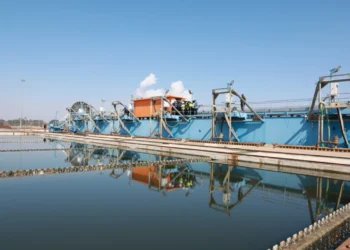
- Zuikerbosch System 5A. The second flagship project is the Zuikerbosch System 5A water purification works. The project’s main objective is to provide an additional 1 200 Million Liters per Day (ml/day) of potable water to the current capacity of Rand Water. Construction of the scheme commenced in 2015 and the project is already adding an additional water supply of 150 (ML/Day) into the system since August 2023.

Zuikerbosch System 5A
Benefits of these Projects
These augmentation projects have since enabled Rand Water to supply water far exceeding customers water demands that usually grows year-on-year by 1.2%. The graph below clearly demonstrates that Rand Water has been growing and increasing bulk potable water supply to municipalities.
In 2023, relative to 2022, the water supply variance as a percentage from planned volumes grew by 6.1 %. In volume terms, Rand Water on average supplied 4 520 ml/d relative with planned water supply demand of 4 262 ml/d. This consumption was approximately 1.5% more than the 4 444 ml/d potable water supplied in 2022. Rand Water has for the last three years been increasing water provision year-on-year for the last five years as depicted by the linear dotted graph in Figure 1 herein below.

Quarter (Q) on quarter from the first quarter of 2023, variance from planned water volumes supplied has increased by 4,2%, 7,5% and 7.4% in Q2, Q3 and Q4, respectively. In effect, Rand Water has been pumping more water into the system than planned water demand.

Financial Impact
The increased water supply to municipalities beyond the budgeted water requirements have seen municipal financial and as a result, negatively impacted Rand Water’s finances. This saw Rand Water’s debtors, despite requests for increased water supply unable to meet their financial commitments to the water entity. Most municipalities are struggling to pay their water bills to Rand Water on time and some have completely stopped.

Rand Water debtors from the Financial Year (FY) 2019 to 2023
In 2019, Rand Water’s debtor’s payment allowances were sitting at 56 days but by end of the financial year in 2023, had gown to a whopping 109 days demonstrating municipal financial distress. Despite many payment options Rand Water made available to the municipalities they still struggle with payment of their water bills. Some of the interventions included extended payment periods and interest holidays.
It is evident from the above that increased water volume in a high-water loss environment is not helpful to municipalities and pumping more water into such a system will not only harm municipalities with high debt, but also cause Rand Water’s increased financial distress and eventual demise in the long run. Insisting that Rand Water pump more water into the system is potentially detrimental to the largest water utility in the country.
Physical Water Losses
According to the No Drop report published by the Department of Water and Sanitation in November 2023, the estimated System Input Volume for Gauteng province is 1 500 000 000 m3/annum and Non-Revenue Water (NRW) is 637 100 000 m3/annum (42.4%) which is above the international norm of 15%.
Gauteng Non-Revenue Water
The major contributor to NRW is largely composed of physical losses (33%). This is due to, among others, pipe leaks/burst and reservoir overflows. The leak repair performances of municipalities ranged from poor to critical as outlined by the No drop Report. The report also points out that the Gauteng’s liters per person pay day water consumption is 279 against the international average of 173 liters per person per day owing to high municipal high non-revenue water.
In 2023 Rand Water, providing wholesale water in bulk to municipalities, peak water supply at the end of the financial year was 5 200ml/d. The 33% physical water loses translates to of 1 7billion liters of water per day when Rand Water’s supplies at peak. This is an equivalent 850 000 000 2L water bottles a day.
Short-Term Focus Ill Informed
To demand Rand Water to simply add more water to the system without understanding its business model is irresponsible and at best reckless. Purchasing raw water from DWS purifying is at a net operating cost of R16 billion per annum without any national fiscus support and appropriate cash backed revenue (municipal water debt payments.) It is a call for the total distraction and complete annihilation of the water supply value chain that provides an estimated 18 million water consumers dependent on Rand Water. To simply demand Rand Water to add water into a water leaking system and trying to silence it from demanding it be paid in time to cover its raw water, chemical, labour and electricity costs is an unfortunate, ill-informed unhelpful expediency with short term focus, completely lacking oversight. It simply flies in the face of basic science.
The Only Sustainable Solution
The solution to water supply challenges in Gauteng still lies with water use efficiency. This is a matter not completely new to the water supply sector and has been at the fore since the advent of the first edition of the National Water Resources Strategy in 2004. The national water resource strategy is the country’s blueprint providing the framework for the protection, use, development, conservation, management and control of water resources for the country.
This strategy makes it clear that “we have enough water to meet our nation’s needs for the foreseeable future. But we need to use that water sparingly, and we must reduce and avoid pollution”. It further emphasises that “We are not on the point of running out of water, but we have to use our limited water supplies more efficiently and effectively” – SIPHO MOSAI
The 2012 edition of this report also indicated that Water Conservation and Demand Management (WC/WDM) is the foremost reconciliation strategy to balance water supply and demand. WC/WDM targets must be met across several priority water supply systems to reduce demand and thus ‘stretch’ the available water resources to the date when the new augmentation projects will be implemented. If this is not achieved, earlier and more severe water restrictions will have to be implemented such as when droughts are experienced. The report suggested that a dedicated national programme is required to deal with water wastage and losses, which will have additional job creation and small business development benefits.
This strategy proposes that specific actions and targets be set different water use sectors, including:
- Implementing an effective water metering and monitoring system;
- Setting and implementing realistic targets for water use reduction;
- Development of incentive schemes’
- Implementing targeted regulation and ensure effective control;
- Obtaining sector commitments;
- Focusing on improved technology;
- Improving associated water management, especially in priority risk areas and
- Supporting effective water use for productive purposes in rural and peri-urban communities.
The third edition of the NWRS dated November 2021 emphasized water demand management to ensure efficient use by all sectors. This should be done through implementation of appropriate water conservation and water demand management measures to meet the social and economic needs of SA, both now and in the future. Furthermore, the report indicated that where water is used efficiently, WC/WDM could postpone the need for capital infrastructure costs such as dams and bulk treatment works. It also called for the resources, scope of work and prioritisation of WC/WDM activities to be determined through an integrated planning process.
The latest No Drop report further underscores that Gauteng’s solution lies with investing in Water Conservation and Water Demand Managements. According to the DWS, there is the insufficient investment in Operation and Maintenance (O&M), resulting in operational inefficiencies of the infrastructure, leading into massive water losses. The lack of O&M has resulted in the rapid deterioration of the condition and performance of the infrastructure.
There are a few interventions that can immediately be affected to set the WC/WDM interventions on the way. These include:
- Enforcement of By-Laws such as tackling unwise water usage;
- Appointment of panel of service providers to fix leaks on an urgent basis;
- Implement Pressure Reducing Valves to manage night flows and
- Restriction of high consumption meters.
The above must be supported by repurposed institutional arrangements wherein water and sanitation revenue is ring-fenced. This would ensure infrastructure investments could be made into the sector enabling sufficient budget towards implement water conservation and demand management measures.