
Alex Rose-Innes
Earlier this year, investigative journalist, Paul Wafula, claimed that fish imported from China to Kenya in Africa had been found containing more than 400 times the acceptable amount of lead, which meant that Kenyans were consuming toxic fish.
When Kenya banned Chinese imported fish, the Asians cried foul and called it trade war. As the country could not compete with the world’s largest continent, it had to renege on the ban. The gun was figuratively held against the heads of Kenyan politicians as the fish supply in Lake Victoria had almost been depleted and the West African country could not match the low price of the imported fish. Local fishermen cannot make a sustainable living charging so little for their catches and lose out as a result.
Apart from the toxic compound found in the fish, it takes days for fish to be shipped to Kenya across 8 000 kilometres. It is off-loaded in Mombasa harbour from where it is transported by road across another 1 000 kilometres. This is already dangerous as there are no legalities in place to ensure the fish reaches its destination in good and frozen condition. Which leaves the question – is cheaper, contaminated fish worth the money saved? When measured against the lives of many poor citizens, the answer should be a resounding NO!
While at first it was thought that the fish from the Asian country contained only high amounts of lead, laboratory tests had now revealed that it also found large amounts of arsenic, mercury and copper. But as with all politically motivated issues and money issues, Kenya’s National Bureau of Standards (KEBS) categorically denied the allegations despite the damning reports.
KEBS officials maintained that the fish get tested according to stringent health standards in the export country and also once the cargo reaches its destination. But, at the time of writing this article, larger samples of fish from Asia had been sampled from other harbours in Kenya and the shocking results became the reason for a series of articles from DailyNation – Rotting from the Deep.
It had been found that in order to set buyers’ minds at ease, the fish was repacked in Kenya in boxes labelled and stamped as FRESH. Tests were done on the box sizes preferred by restaurateurs and the results second time around were said to be even worse than the first.

Fish from Asia is downloaded and repacked to show high safety standards at Kisumu harbour in Kenya. (Inage: Jeff Angote.)
Meanwhile, scientists from the University of the Western Cape in South Africa had found that fish caught by small-scale fishermen in Kalk Bay contained large amounts of industrial chemicals, pain killers, antibiotics and anti-retrovirals for HIV sufferers. According to these findings, the sea around Cape Town is severely polluted and these toxic substances are finding their way into the flesh of fish caught off the coast.
Snoek, bream and other commercially sold freshly caught fish had the analgesic and anti-inflammatories Diclofenac and Acetaminophen, the anti-epileptic drug Carbamazepine, antibiotic Sulfamethoxazole, disinfectant Triclosan and various industrial chemicals found in pesticides, flame retardants and personal care products in their flesh. Senior Chemistry professor Leslie Petrik and Cecilia Ojemaya found 15 different chemical toxins in the fillets, liver and intestines of the fish.
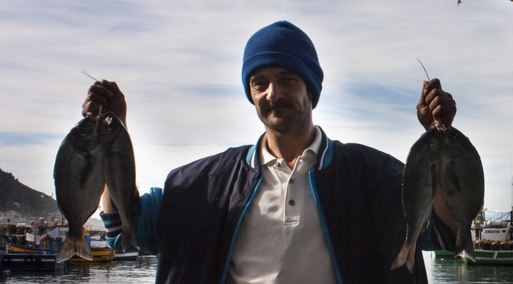
Small-scale fisherman in Kalk Bay Harbour, SA (Image: Steve Kretzmann/GroundUp
And who is to blame? Apart from the world using Africa and its oceans as dumping ground, poorly treated sewage is flowing into our seas. According to Prof Petrik, ingesting these has a different acute and chronic risk associated with it. We are literally what we eat and in this instance, we are killing ourselves.