Alex Rose-Innes
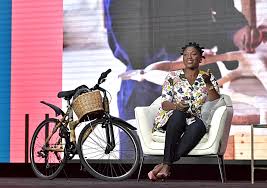
Bernice Dapaan, today one of the World Economic Forum’s Young Global Leaders, launched the Ghana Bamboo Bikes Initiative to create local jobs and promote low-carbon transport in her country with half of its employees being women.
So successful had her project been that she had secured the support of the United Nations (UN) Development Global Environment Facility (GEF) Small Grants Programme. And that was only the beginning of Bernice’s success story.
Bamboo is abundant in Ghana and for every bamboo plant cut down to make a bicycle, Ghana Bamboo Bikes Initiative plants 10 more. Bamboo, being stronger than steel (tenstile), is a cheaper, more sustainable material. It also takes less electricity to make than a metal bicycle and these unique frames are completely recyclable.
“It’s a new innovation. There were no existing bamboo bike builders in our country, so we were the first people trying to see how best we could utilise the abundant bamboo in Ghana,” Dapaan told the UN Forum.
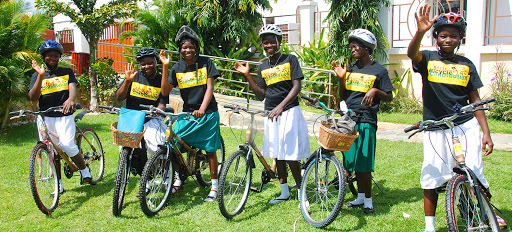
Besides encouraging Ghanaians to swap vehicles for affordable bicycles and so decrease the carbon footprint and become fit and health, the Ghana Bamboo Bikes Initiative is assisting student who walk for hours to get to school and free up for time for them to study, by donating one bicycle for every one sold to a student.
Dapaan knows exactly how transformative a shorter journey to school can be to academic performance. She grew up living with her grandfather, a forester in a rural part of the country and each day had to walk for more than three hours to get to school and after school spent another three-and-a-half hours walking home. Her grandfather later bought her a bicycle when she finished school and wanted to go to university and the seed of her future success was sown.
The experience inspired her to launch Ghana Bamboo Bikes Initiative with two other students at college. To date, more than 3,000 road-, mountain and children’s bicycles had been sold. Dapaan said 10,000 bikes would be donated to schoolchildren over the next five years.
The venture is providing much needed sustainable incomes, particularly for women in rural communities who now have the means to provide for their families and children. The initiative also teaches young people to build bicycles and more than 50% of trainees had been women. Even bamboo suppliers now have a regular income.
Dapaan hopes to employ 250 people over the next five years and is looking to partner with local NGO’s to build a childcare facility so mothers could continue working and earning an income. She is adamant to promote a cycling culture in Ghana and just as committed to reducing emissions in the transport sector and contributing to the UN’s Sustainable Development Goals. “I love the idea of reusing bamboo to promote sustainable cycling. People want to go green, low-carbon, lean-energy efficient,” she said.
Produced as an innovative means to combat climate change, the strong but light bamboo bicycles are being used for multiple purposes in a variety of terrains across the country. “Though we have not fully reached the stage of mass production, our current production rate is about 20 bicycles per month,” said Dapaan. The demand for these bikes had grown steadily from local and international buyers.
Ruby Sandhu-Rojon, UN Resident Coordinator in Ghana, praised the Ghana Bamboo Bike Initiative for the innovative efforts while encouraging the production of tailor-made bicycles responsive to the needs of rural women, particularly pregnant mothers. Sandhu-Rojon said these bicycles could reduce maternal mortality and accelerate the achievement of other Millennium Development Goals.
“The use of bamboo as the raw material for the initiative is a good innovation putting Ghana on the world map. Bamboo can produce oxygen to displace carbon dioxide in the atmosphere, reducing climate change,” Ruby said during one of the many award functions where Dapaan walked away as winner.
The Ghana Bamboo Bike Initiative also produces tricycles supporting women carting goods from their farms to the market. With support from the African Union Women, the initiative is producing a prototype bamboo bicycle ambulance to support emergencies in rural Ghana.
The Ghana Bamboo Bike Initiative had so far won dozens of awards including the Seed Initiative, Impact Business Awards and the World Business and Development Awards.
In November 2013 the initiative received widespread global attention when the UN Secretary General, Mr Ban Ki-Moon and the Executive Secretary of the UNFCCC, Miss Christiana Figueres, test rode the Ghana-made bamboo bikes. Dapaan’s bicycles were also featured at the Momentum for Change Lighthouse Activities” at the COP19 in Warsaw.
The business is also developing into a sound social enterprise after establishing a training centre and a bike factory at Nkawie in the Ashanti Region of Ghana.