Alex Rose-Innes
From Nkhata Bay, Malawi in southern Africa, comes this heart-warming story about community involvement, economic empowerment and the necessity of female education.
If not for the timely intervention of members of her community, Catherine Mkandawire would have become another statistic of child marriages in her country. Malawi has one of the highest child marriage rates in the world. Here, 42% of girls are married before 18 and 9% before age 15. At 13, Catherine had no future other than that of a child bride.
The benefits of education in poor societies
But by avoiding that fate, Catherine was able to obtain an education and earned an advanced degree in community development. Today, at 28, she is a climate advocate and a leader in United Nations Population’s (UNFPA) Safeguard Youth Programme, funded by the Swiss Agency for Development and Cooperation. This organisation champions youth which includes protecting girls from child marriages
Catherine is a perfect example of how, by promoting economic empowerment for vulnerable girls, a difference can be made. With Malawi’s national poverty rate 52%, this poverty drives desperately poor families to marry off young daughters, expose them to gender-based violence and other harmful practices.
BLURB:
“Most young people, especially girls, lack so many things. This makes them easy targets for exploitation. For them to be safe, they need to be able to make their own decisions. This requires access to opportunities.” – Catherine Mkandawire
Just as UNFPA, she recognises that livelihoods, sexual and reproductive health, rights and climate change are all interrelated. “More extreme weather due to the destruction of our environment brings hunger to communities. With parents unable to feed their children, young people are exposed to high levels of risk, including in their own behaviour,” she says.
How Catherine makes a difference
This young woman decided that she must lead in protecting and preserving the environment and earn a sustainable living from it to inspire her peers to follow in her footsteps towards a better future.
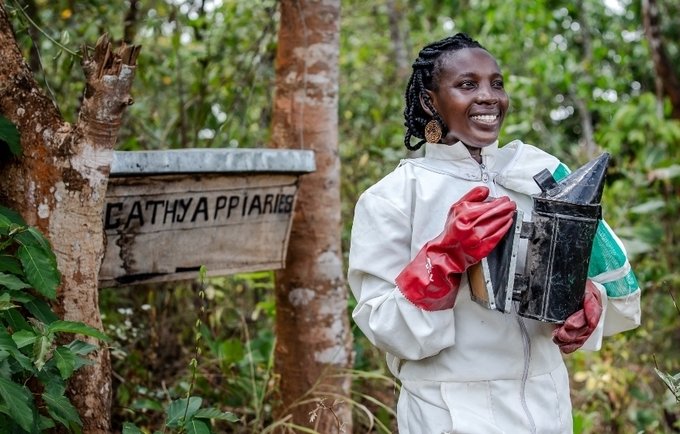
She started by planting 2,500 pine trees at the foot of a mountain on family land, added beehives producing 20 litres of honey per week and a fish pond surrounded by wildflowers and a banana crop. Today, her diversifying of land use beyond subsistence farming to a smaller and more sustainable set of activities, is reaping rewards. With the money she makes selling honey, Catherine pays the salaries of five employees, school fees for her two siblings and supports her ageing parents.
“At first, people were sceptical of this project, but when they saw it working to conserve the environment, more youths started coming to learn from me,” she said. “Even the chief from our area donated land for the youths to expand the forestry project.”
Building climate resiliency
Malawi is one of the least electrified countries in the world. According to the World Bank, only 11% of the population of 18 million is connected to the electrical grid. The global average is 90%. In rural areas, a mere 4% have access to electricity. This has contributed to deforestation. Poor people illegally cut down trees in national parks and forest reserves to provide charcoal for cooking and selling. Since 2010, Malawi has lost an average of 42,000 hectares of forest. In 2016, the government committed to restoring 4.5 million hectares by 2030, more than a third of its land area.
Climate talks and enviro conservation
Once a week, Catherine holds climate talks about environmental conservation, with this being an entry point to engage youths on sexual and reproductive health issues. Many of the young people she has trained can now pay for their own school fees by working at climate-related jobs, important in the face of extreme weather events such as the recent Tropical Storm, Ana. “Before I started this initiative, charcoal burning was destroying our forests,” she says. “But now, with many youths doing beekeeping, there is hope that our forests will survive,” she said.