
Junaid Kleinschmidt
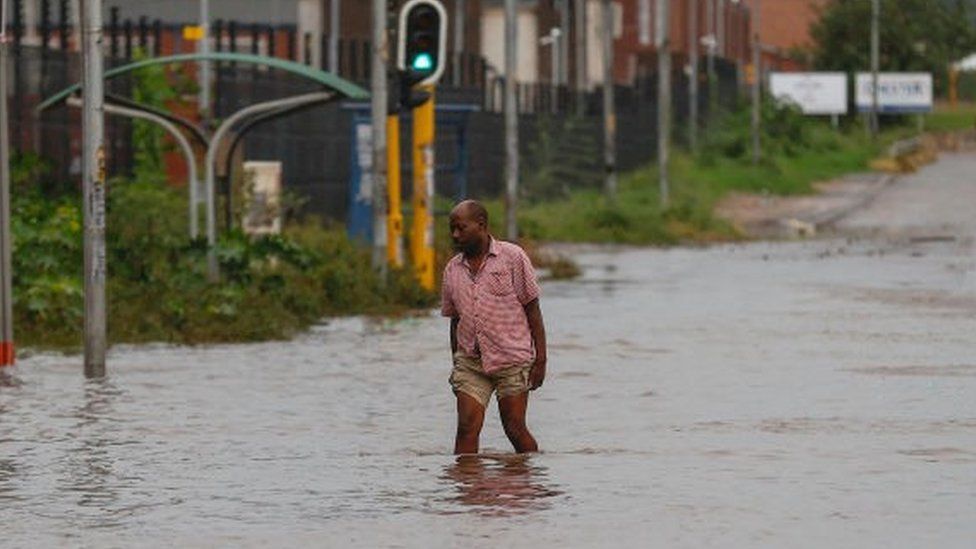
Climate change and the accelerated occurrence of natural disasters could arguably be one of the greatest threats facing humanity. Just in the last few weeks, we have seen the disastrous impact that unprecedented flooding has had in our own KwaZulu-Natal. It is now essential to accurately predict climate change well in advance to help us better plan for its potentially devastating impact on population and infrastructure security.
Successful AI-based studies in the United States (US) are already predicting weather movements in California as well as floods in the US Midwest. Over 40 years, we’ve seen 5000 billion tons of ice melt in the Artic. Studies are happening right now looking at Canada, Greenland, and other Arctic areas, that are using the power of Artificial Intelligence (AI) technologies to analyse the movements of the Greenhouse effect – i.e., the process that causes the planet to warm.
AI deployed and run on the correct infrastructure can predict the behaviour of extreme weather events across the globe and do so days in advance. At 100,000 times faster than traditional numerical weather models, this is a significant step towards building a digital twin Earth – a virtual model of a real-world object, machine, or system that can be used to assess how the real-world counterpart is performing, diagnose or predict faults, or simulate how future changes could alter its behavior.
AI tools such as convolutional neural networks can analyse large-scale circulation patterns and high-precipitation events associated with extreme weather. There are also other AI models such as NVIDIA’s FourCastNet, which emulates the dynamics of global weather patterns and predicts extremes with unprecedented speed and accuracy. A seven-day forecast is done in a fraction of a second, five orders of magnitude faster than Numerical Weather Predictions (i.e.,100 000 times faster).
When it comes to weather and climate prediction, AI tools can help with short-term predictions (± seven days) and long-term predictions. Stanford researchers developed a machine learning model that uses atmospheric patterns to predict extreme precipitation which may lead to flooding. This tool can be used in the short term for predicting when disaster may strike and in the long term for building infrastructure that is resilient to climate change.
The SA weather service has been using global best practice meteorological tools, however, these tools run on ageing infrastructure. However, late last year, the SA Weather Service set out to procure and implement a high-performance ICT infrastructure. Yet, this ostensibly only performs the same as traditional Numerical Weather Prediction forecasting models. It is expensive, time-consuming, and limited. Where are the AI tools that we need for weather prediction in this country?
The reality is that Public Cloud and High-Performance Super Computers, specifically designed and engineered to perform AI are needed to run models on terabytes of data, analyse these datasets, predict patterns, and visualise the data using earth system models and geospatial mapping. Data Scientists, Meteorologists, IT infrastructure, and Engineering staff, are now an integral component of numerical weather predictions. Based on the recent flooding, I would say we are in desperate need of this predictive power.
What we see and hear from the global climate modelling community is that the AI models along with the science are getting much stronger. In South Africa, I would recommend we pool our economic resources together, championed by the SA Weather Service and research institutes to co-invest not only financial resources, but time and effort to implement the correct models, geospatial mapping, and earth modelling frameworks to proactively predict extreme precipitation events. The open-source algorithm “software” is free to implement, but putting this together with the right minds, financiers, and collaborators is the only way to yield successful results.
In KwaZulu-Natal, for instance, this cost could range between R25m-R100m or more depending on the full scope. Yet, between the public and private sectors, and based on the rampant destruction of the recent flooding, I’m sure a plan can be made. It must.