Jorge Appiah’s Solar Taxi e-mobility company is providing climate-friendly travel options to commuters in Ghana.
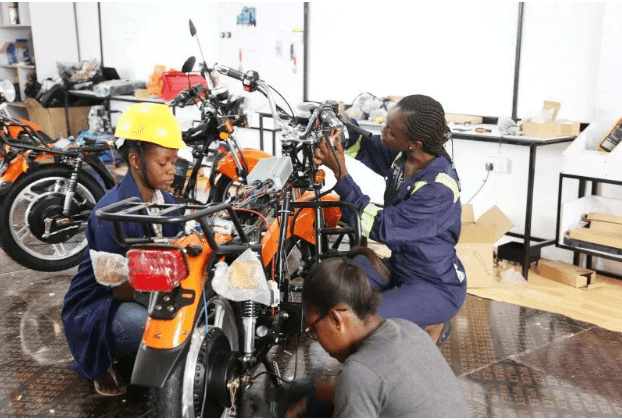
Apart from offering affordable e-haling taxi services on a specially designed phone app, his team of mostly females assembles, sells and leases electric motorbikes. On top of this, this enterprising businessman also distributes imported electric cars and plans to start a local assembly line soon.
Solar Taxi came into being as petrol costs increased, affecting not only the pockets of workers who needed transport to and from work but also the price of food, healthcare and other goods. Jorge realised that he had to find an alternative, sustainable solution. His company started building a prototype solar-powered vehicle with available parts and spares they could find and borrow as financing remained a challenge.

Mastercard to the Rescue
But, any good idea eventually finds its way to funders. In Jorge’s case, when the Mastercard Foundation heard about his enterprise, the organisation supplied funding, helping Solar Taxi get off the ground and on its green wheels, so to speak.
Seeing Solar Taxi’s success, additional scale-up funding from MasterCard Foundation helped launch its two- and three-wheelers into the market. These bikes are fully assembled in Ghana using parts imported from China and India.
By 2021, Solar Taxi was geared to bring electric cars into the country. Jorge and his team currently import e-vehicles from different manufacturers and sell them to clients. In association with a Chinese partner, market research had been undertaken and a full assembly plant is planned for later this year. Jorge is looking towards building these vehicles from kit to make them affordable and within the reach of not only commuters in Ghana, but across the African continent.
Success is Knocking at the Door
Today, large e-commerce and delivery companies in Ghana are using Solar Taxi’s electric motorcycles to deliver customer orders. For those without the financial means to buy a motorcycle, Jorge offers a leasing option and for corporate customers, banks grant loans to add Solar Taxi vehicles to their fleet.
Another milestone this year was the launch of a ride-hailing app, exclusively for electric vehicles. The use of the app is increasing, with approximately 100 rides per day. Jorge provides drivers with electric vehicles but also has drivers who own their Solar Taxi electric cars, on its books. This creates meaningful and sustainable, not to mention climate-friendly, incomes for many.
In the meantime, another company had come on board to provide finance, realising that Jorge has a winning concept and the money would be used to drive its future plans.
Charging Options
The electric two- and three-wheelers can either have self-charging options which are part of the vehicle or have a solar hub installed at home or office, generating solar electricity. The electric delivery bike has a removable roof with solar panels installed on top. “These panels recharge the vehicle when it is parked. However, most people still prefer the off-vehicle integration for aesthetic reasons,” Jorge was quoted in an online statement.
The high-capacity vehicles have a range of between 450km and 600km before needing a charge. The daily usage in the cities where Solar Taxis operate is mostly no more than 20km for most people, meaning charging is only necessary once per week.
Jorge says Solar Taxi is not pushing public charging infrastructure at the moment, but rather focusing on home installations for fast charging. “We have one or two clients who did an installation for public usage and we will consider it for the future, but at the moment, it is not a priority,” he said.
Green opportunities
While the average Solar Taxi customer might still not be ready to go completely off-grid, solar power generation presents other avenues for the company to expand. Jorge, ever looking for other business avenues, is also considering power generation for general use and his team is working on several designs for micro-grid solar charging stations, part of his long-term vision.
The company has also noted an opportunity to electrify all transportation on university campuses in Ghana under its Solar Campus programme. “The main goal is to work with universities to go green on campus. We want to instil a culture of environmental consciousness in students and make them ambassadors of e-mobility,” this driven and future-orientated businessman said.