

“IN DOING THIS, WE HAVE ENSURED THE SUSTAINABILITY OF OUR PROTECTED AREAS…”
The Department of Environment, Forestry and Fisheries has been allocated R8.2 billion for the 2020/21 financial year to help in the implementation of our environmental programmes and post-lockdown economic recovery initiatives and programmes.
Delivering the Department’s reprioritised budget policy statement for the 2020/21 financial year during a virtual Parliamentary sitting last week, the Minister of Environment, Forestry and Fisheries Ms Barbara Creecy said the monies allocated for the present financial year will be utilised to create a nature-positive future” for the country.
During the national lockdown to stem the spread of Covid-19, the department’s four entities – South African National parks (SANParks), South African National Biodiversity Institute (SANBI), iSimangaliso Wetland Park Authority (iSimangaliso) and the South African Weather Service (SAWS) – have been unable to realise their usual income and remain self-sustainable.
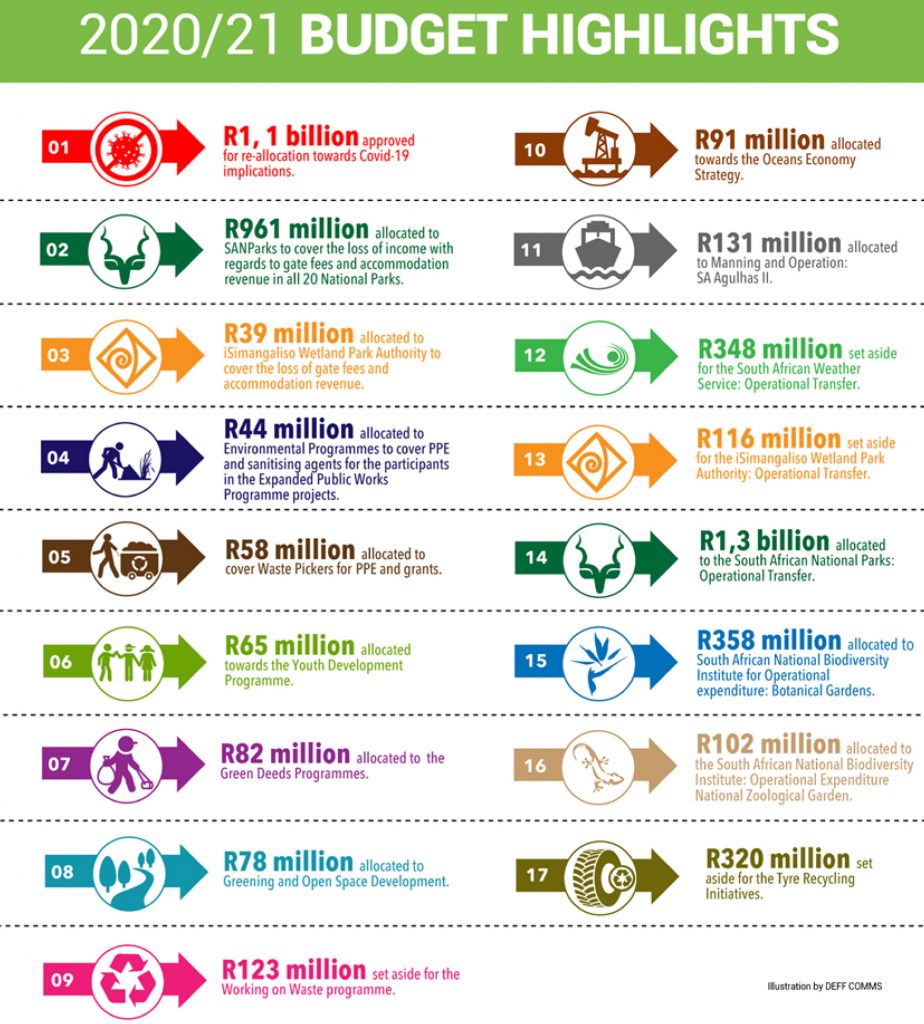
To ensure these are able to continue to deliver on their mandate despite the pandemic, the department has shifted a considerable amount of funding (R1.1 billion) to the four entities, from the departmental budget. An amount of R961 million has been transferred to SANParks and R39 million to iSimangaliso to cover the loss of income with regards to gate fees and accommodation. Also assigned has been the amount of R44 million to the Department’s Environmental Programmes to cover personal protective equipment (PPE) and sanitising agents for the participants in the Expanded Public Works Programme (EPWP) projects.
“In doing this, we have ensured the sustainability of our protected areas and the significant role they play in supporting our country’s mega-biodiversity. We have also ensured the future sustainability of our contribution to nature-based tourism and its longer-term employment potential,” said the Minister.
To further secure the financial viability of the four entities, the following decisions were made:
- Capital spending in all four entities has been postponed while alternative funding sources are sought for 29 projects through the Presidential Sustainable Infrastructure Development Programme (SIDS).
- Budgets initially earmarked for capital spending have been shifted to prevent job losses and ensure duties such as anti-poaching and ranger services, wildlife management, the day to day running of the country’s botanical gardens and the Tshwane Zoo, weather prediction services essential for shipping and aviation purposes, and the extensive programmes of scientific research co-ordinated by SANBI, continue.
Innovative approaches to sustainable funding
Minister Creecy said national and provincial parks face revenue shortfalls and tough choices at this time. To assist, the institutional arrangements for the management of protected areas are being reviewed to find ways to ensure their survival. In response to the present crisis, the Minister has adopted a two-pronged approach informed by South Africa’s current position as the President of AMCEN, and the important role that the biodiversity economy plays in the country’s development plan. Firstly, a Ministerial Task Team on resource mobilisation for conservation COVID-19 responses has been established.
It comprises experts from diverse backgrounds to consider innovative approaches to sustainable funding for the conservation sector. The task team will also identify potential funding sources that could be mobilised. “Initial work is focusing on an emergency response particularly for NGOs in distress, but with the view to longer term sustainable funding mechanisms and models,” said the Minister.
Diverse investment sources are being considered, including innovative financing solutions, debt for nature swops, grants, and impact investments. The second initiative is being worked on by the department with the International Union for Conservation of Nature (IUCN) and the Endangered Wildlife Trust (EWT) which will find ways to support the post-Covid recovery of the biodiversity and conservation sector and build a nature positive future.
Minister Creecy said greater co-ordination between government and non-governmental sectors is required to restore ecosystem services, protect strategic water sources and develop of green infrastructure. “Despite budget cuts and a late start to our expanded public works programme, we still aim to create 16 315 job opportunities this year.
“We will ensure that 60% of the people who benefit from the implementation of our programmes are women, 65% are young people and 2% are people with disabilities,” she said.
Work is continuing on delineating 11 strategic water sources, the development of a National Joint Wetlands Management Framework, and the clearing of invasive plant species and rehabilitation of wetlands, riparian zones and degraded land. The fishing sector remains a significant contributor to food security and the economy. Stabilising the sub-sector through the allocation of longer-term fishing rights is critical to attracting investment into the industry.
When the Department issues 15-year fishing rights to small-scale fishers in the Western Cape later this year, it will, for the first time, mark the completion of the Small-scale 15-year Rights Allocation Process to over 10 500 fisher men and women organised into 110 co-operatives nationwide. Minister Creecy said the rights allocation process is a first step to formalising and developing small-scale fishers who even before the Covid-19 pandemic, faced enormous inequality, insecurity and barriers to economic participation.
The revised period for the commencement of the 2020/21 FRAP process for the granting of commercial fishing rights was published on the 26 th June 2020 for comments. The FRAP2020/21 Project Plan has been revised to meet the new deliverables and timeframes. The Minister said of crucial importance at this point was the stabilisation of the aquaculture sector and the 4 875 jobs it sustains. In this regard, consultations on the Aquaculture Bill are being finalised. 2020 also marks the coming into force of the Paris Agreement on Climate Change.
The department is reviewing contributions to reducing emissions and building resilience to the impacts of climate change, through it Nationally Determined Contributions. As the country moved to a “nature-positive future”, the department has called for public comment on three more Renewable Energy Development Zones (REDZ) namely Emalahleni in Mpumalanga, Klerksdorp in North West and Beaufort West in the Western Cape. This will bring to 11 the number of REDZ in the country. The declaration of these zones will fast-track the development of renewable energy projects in line with the integrated resource plan.
The Minister said waste recycling and the transition to a circular economy are areas that need to be speedily up-scaled to create jobs, formalise micro-waste enterprises, divert waste from landfills and the environment and improve the overall system of waste management.
R1 MILLION set aside for youth projects
BY ZIBUSE NDLOVU
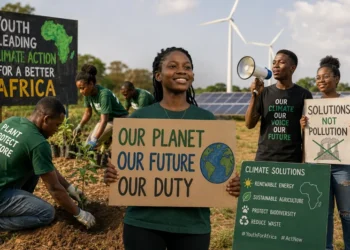
The Department of Environment, Forestry and Fisheries has earmarked R1million to fund youth-led projects tackling the issues of climate change, waste management and biodiversity loss.
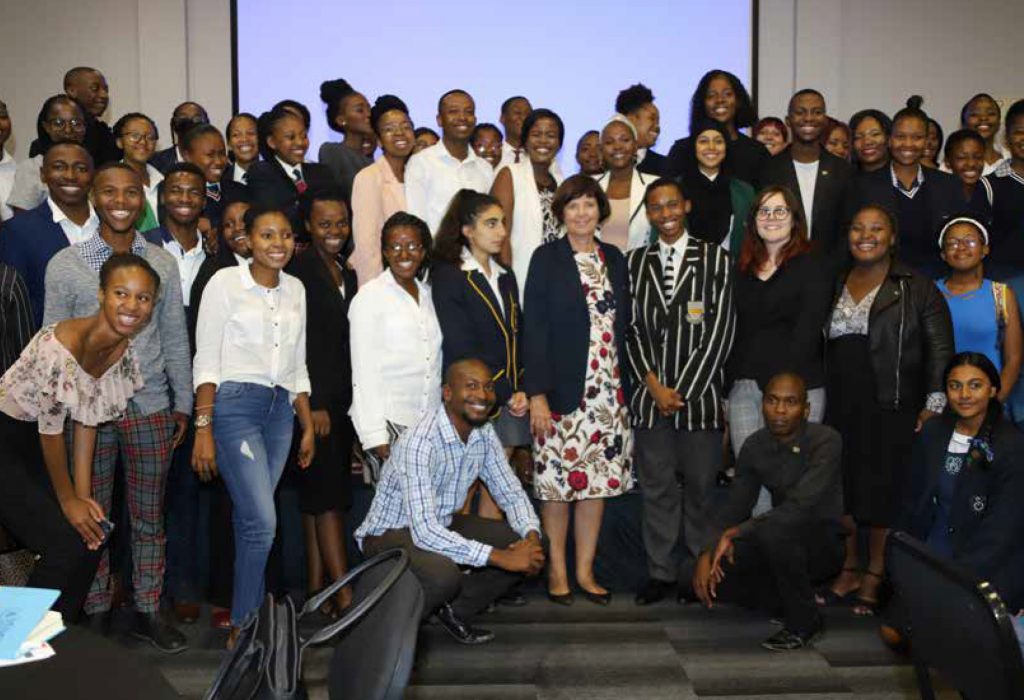
This was revealed during a virtual Youth Environment and Sustainability Dialogue hosted by Minister Barbara Creecy on youth day, under the theme: Youth Power: Growing South Africa together during the period of Covid-19.
Minister Creecy said the decision was a response to the call for more support for young innovators and entrepreneurs. More than 100 youth from across South Africa took part in the virtual dialogue during which they expressed concern about the dire economic impact of Covid-19 and its effect on achieving the goals set out in the 2015 Paris Agreement on Climate Change. Among the suggestions presented to the Minister, by youth representing 15 organisations, was a green recovery mechanism that is gender-and-youth responsive.
The youth asked for the country’s green recovery strategy to include more rapid introduction of renewable energy, greener public transportation and the upscaling of the circular economy to better manage waste. In a joint statement, the youth stressed that climate change be addressed with greater urgency by all levels and sectors of government.
A concern was also expressed for vulnerable community members including waste recyclers who play a significant role in waste diversion from landfills but work under dangerous and insanitary conditions. The applications for funding opened on 1 July and will close on 31 August 2020. Adjudication by an independent panel is expected to take place in September and October.
In November, grants of R100 000 will be awarded to 10 successful projects. “This pilot initiative is one of our ways to enable young entrepreneurs to develop innovative solutions to create new economic opportunities in a more climate resilient and sustainable economic path,” said the Minister.
WHAT YOU NEED TO KNOW:
Applications for funding can be submitted in an application form available on the department’s website www.environment.gov.za under Projects and Programmes. Results areas that would qualify for the support:
- Climate Change.
- Strengthen resilience and adaptive capacity.
- Reduce and/or avoided greenhouse gas (GHG) emissions
- Waste.
- Reduce waste generation through prevention, reduction, recycling and reuse.
- Biodiversity and Ecosystems.
- Equitable benefit and sustainable use, conservation, management of species and ecosystems and restoration of degraded ecosystems.
Applicants and the type of activities that will be eligible for support:
- People: Youth organisation; youth-led organisations; and organisations undertaking youth climate, waste, biodiversity, forestry and fisheries related implementation.
- Activities: Stakeholder engagement and consultation. n Prefeasibility studies.
- Feasibility studies.
- Project structuring.
- Identification of full project financing.
Supporting documents that are needed:
- Profile of business and business owner/partner or owners/ partners.
- Certified copy of identity document of business owner/partner or owners/partners.
- Letter of support from the bank confirming banking details of the business
- Proof of physical address of the business.
- Additional supporting information may be requested during the pre-screening process.
- The adjudication of projects will take place in September and October 2020.
- In November grants of R100 000 will be awarded to 10 successful projects.
- Announcement of the selected projects will be made in November 2020

For more information, visit www.environment.gov.za Call centre: 086 111 2468
| Greening Afrika Partnered Features Disclosure: Our sponsored stories are in-depth and produced independently from Greening Afrika in association with paying partners. Collaborating with our partners, we ensure all stories meet our standards of editorial quality and offer information of value to readers. For more information, Engage with our team: advertising@mediatorque.co.za |