
Alex Rose-Innes
The World Economic Forum (WEF) had published a document on how to address poverty in Africa, especially in the sub-Saharan region of the continent.
Hailu Mekonnen, Chief Poverty Reduction Specialist for the African National Bank (AfDB), called the sub- Saharan poverty a multi-dimensional problem with varying dimensions and many challenges. In an international interview with Reuters, he said that poverty in Africa is the main reason for food insecurity and the largest threat to the region’s residents.
Despite the many challenges facing the continent which is already experiencing the effect of severe climate change, the WEF is more optimistic. In the past two decades, Africa had experienced a continued economic growth. According to the International Monetary Fund (IMF), the fastest-growing countries in the emerging sub-Saharan region had already seen poverty being reduced by between 41% in 2019.
However, the IMF conceded that the population growth in Africa is “monumental.” The United Nations (UN) estimates that by 2050, the continent’s population would have grown by more than one billion, with a predicted 200 million people between 15 and 24.
In its report, the WEF says that in 2020, more than 660 million Africans owned smartphones, translating to 80% of the overall population. Technology had become a part of everyday life and was changing the lives of sub-Saharan residents and would continue to create opportunities for financial growth in the future.
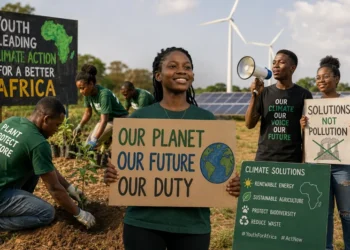
The WEF is however realistic and stated in its report that while there are significant signs of progress, sub-Saharan Africa faces major risks such as the effect of climate change on agriculture, which would severely impact food security.
There is no denying that the continent’s future prosperity is under threat and these threats are growing. Climate change is already worsening food insecurity. Other natural threats such as the devastating crop destruction by grasshoppers in 2020 had reduced the harvest sizes of wheat, maize and many other crops. The number of undernourished or food-insecure people grew by between 37 million and 122 million between 2014 and 2017 to more than 800 million, partly because of climate shocks.
Developing countries are experiencing 20% more extreme heat than in the late 1990’s. These higher temperatures reduce the availability of water for irrigation by drying the air and soil. Climate change is also at the heart of the increase in pests and disease, livestock farming and reducing labour productivity. With a rise of 4°C in the temperature, crop seasons in most of sub-Saharan Africa could shrink by 20% or even more.
But, agriculture also contributes to the climate challenge. Greenhouse gas emissions from agriculture which accounts for approximately 25% of global emissions are expected to increase to 70% of emissions from human sources by 2050 and the WEF had called for an urgent and large reduction of these to meet climate targets.
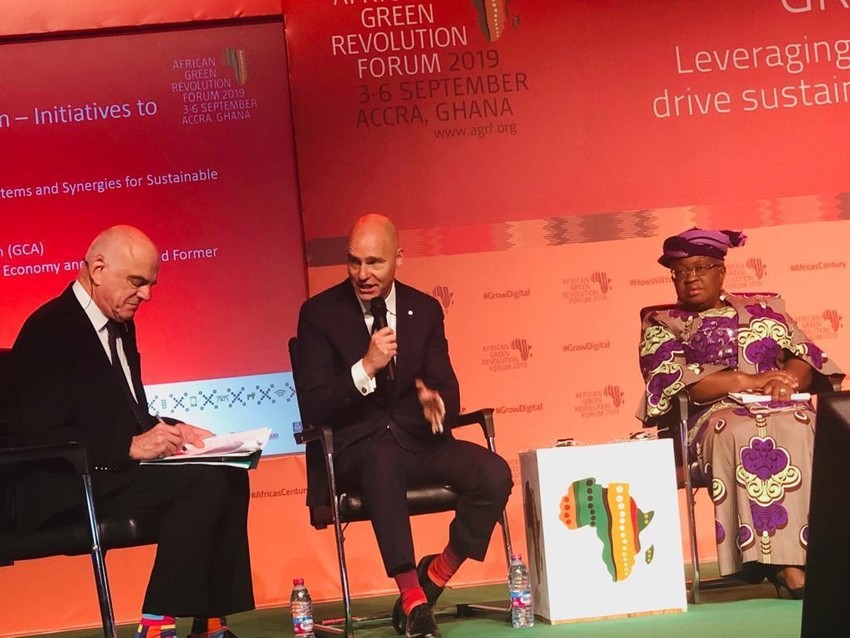
Patrick Verkooijen, CEO of the Global Centre on Adaptation, said at the African Green Revolution Forum in Accra in Ghana that just as the rest of the world needed to adapt to the new climate reality, so does Africa. But, according to him, there is currently still a huge discrepancy between what is necessary to be done and what had been achieved thus far.
He highlighted five areas which should be speedily addressed, the most important high- end research and development to be applied in conjunction with traditional farming knowledge.
Policies and incentives to kick start local, national, regional and international markets to ensure rural areas would become sought after by farmers to build sustainable livelihoods. Verkooijen explained that only a climate-smart approach would see the success of this venture.
Up-to-date weather information, digital soil maps and critical data and analytics should be available and rural farmers should be educated on the use of progressive technology.
Verkooijen said that private financial assistance would be crucial in order to finance the abovementioned. He called on governments to develop transition funds for farmers affected by climate change.
And finally, the necessary resources should be provided for farmers, such as stress-tolerant crops and livestock and new forms of irrigation. The global average of irrigated land is 20%, but in Africa, it is only 5%. At the same time, traditional energy should be replaced with solar to cut costs and increase the financial benefit for rural farmers.