

Alex Rose-Innes
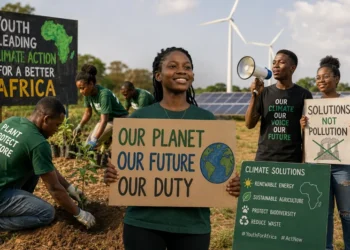
For Africa, green is not just a colour anymore, but refers to the pathway towards economic revival and sustainability with careful use of the earth’s finite resources. Green industrialisation is the new buzz word on the continent and seen as the Holy Grail of the continent’s socioeconomic transformation.
At recent economic forums in N’Djamena in Chad, Addis Ababa in Ethiopia, Abuja in Nigeria, Rabat in Morocco and even New York in the United States, African experts had expressed their support for green industrialisation.
In the United Nation’s Economic Report on Africa, it is made clear that green initiatives would move Africa from the periphery to the centre of the global economy. This was the opinion of Fatima Denton, director of the Bureau of Educational and Cultural Affairs (ECA) of the United States’ Special Initiatives Division.
Africa’s green industrialisation advocates had borrowed from the Sustainable Development Goals (SDG’s) adopted by world leaders in 2015 and the Paris Climate Change Agreement of December, which promote green initiatives.
Slow green change
However, experts agree it might be difficult to sell Africa’s oil and natural gas exporters such as Angola and Nigeria, on limiting fossil fuel drilling. For both countries, oil accounts for more than 90% of exports and at least two-thirds of the national budget. Before the oil price crash, even countries just discovering oil, Ghana, Liberia and Sierra Leone, had anticipated a financial windfall from the sector. These countries fear that limiting fossil fuel investments may severely damage their economies.
BLURB:
African countries must take advantage of new innovations, technologies and business models using natural resources optimally and efficiently – 2016 ECA economic report.
Harvard University business professor Michael E. Porter, in Harvard Business Review, opined that the reason for countries being slow in embrace green technology was the result of a lingering belief that environmental regulations erode competitiveness.
Salifou Issoufou and Nama Ouattara, economists with the International Monetary Fund (IMF) and World Bank respectively, shared a research paper with the question of greening and its ability to increase productivity. They advised African governments to adopt a cautious approach in attempting large-scale investments in green technologies. The costs were great to change from current industrialisation to a greener option. The argument that Africa contributed the least to global warming; it should not be compelled to adopt mitigating climate change policies, was again highlighted during the most recent COP 26 in Glascow by South Africa’s minister of Environment, Barbara Creecy.
Despite naysayers, green industrialisation had grown in leaps and bounds with various African governments playing a key role in driving the growth of renewables. Cities, communities and companies are leading the rapidly expanding “100% renewable” movement, playing a vital role in advancing the global energy transition.
Possibilities of green industrialisation in Africa
Carlos Lopes, executive secretary of the Economic Commission for Africa, said that Africa had the potential, better access to finance and a window of opportunity as renewables had become much more affordable.
Professor Mark Swilling of the Centre for Renewable and Sustainable Energy Studies at Stellenbosch University in South Africa, said the added value of renewables is their positive impact on a company’s profit, its social responsibility activities and its environmental responsibility.
The continent’s capability for “leapfrogging” constitutes a significant economic advantage for the region, as African countries implementing green initiatives would have direct access the latest available technologies on the market. “Industrialised countries, on the other hand, will have to retrofit older infrastructure”, Lopes said. Many African countries are planning or already implementing green projects, with Ethiopia and the Democratic Republic of the Congo leading the green transition.
Last February the World Bank assisted Ghana in launching a Climate Innovation Centre in the capital, Accra, to support a green growth strategy. The centre is working with about a hundred local technology companies. Furthermore, Nigeria’s Renewable Energy Programme is involved in a low-carbon development project to provide green electricity for its capital, Abuja. The project is the first of its kind in Africa and the second in the world.
Overall, a general belief among Africa’s development experts is that going green is no longer a moral question but a socio-economic imperative and considered the new pathway to the continent’s industrialisation.