

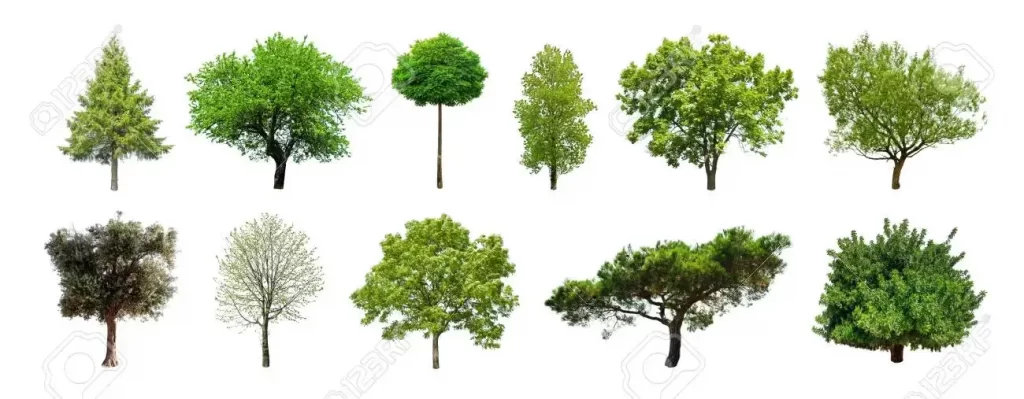
The total number of tree species on earth is estimated to be around 73 274, with another 9 186 yet to be discovered, according to a study by a team of researcher based at the University of Stellenbosch (SU). Approximately 40% of these undiscovered tree species are in South America.
Published in PNAS, a peer-reviewed multi-disciplinary scientific journal, the new global estimate of the number of tree species is 14% more than previous estimates of 60 000 species (2017) and 64 000 (2018).

Significance of trees
According to environmental experts, trees are important for the earth in many respects, some of their benefits include, among others, purifying air and thus combating climate change and also providing stability to the planet’s ecosystem. A team of 147 researchers from 153 different institutions globally collaborated on this research project. One of the participants was Professor Cang Hui, a bio-mathematician in the department of mathematical sciences at SU.
“Biodiversity estimation at regional and global scales is challenging because only a tiny fraction of the ecosystem in areas of interest can be feasibly surveyed, and the estimates from these surveys need to be extrapolated to areas orders of magnitude larger,” explained Hui
Latest statistical methods
The study found that 43% of all earth’s tree species occur in South America, followed by Eurasia (22%), Africa (16%), North America (15%) and Oceania (11%). The research team relied on a ground-sourced global database comprising 64 100 species to develop estimates of the number of tree species at biome, continental and global scales. They managed to estimate the number of tree species that are currently unknown to us by using some of the latest statistical methods.
The research team said one of the most fundamental questions in ecology is how many species inhabit the earth. And that in the case of trees, scientists still do not know for sure how many species there are, even though trees are among the largest and most widespread organisms on the planet.
Contributing to conservation of trees
It is hoped that the information gleaned through this research study would immensely contribute to tree and forest conservation efforts as well the future discovery of new tree species in other parts of the world. “For instance, considering that we estimated that about 31 100 tree species are expected in South America, and those known to science are about 27 200, there might be another 3 900 tree species yet to be discovered in this continent and most of them could be endemic and located in diversity hotspots of the Amazon basin and the Andes-Amazon interface,” noted the research team.
Forest conservation therefore becomes the main priority not only in South America, but also of tropical and subtropical forests in other continents. Direct human activities such as logging, agriculture, cattle, ranching, mining, oil extraction and dam building are blamed for the current rapid deforestation of the Amazon and other similar dense forests in Asia and Africa.
Man-made changes
Studies such as this highlight the vulnerability of global tree species to man-made changes to land use and future climate: “Losing regions of forest that contain these rare species will have direct, and potentially long-lasting impacts on the global species diversity and their provisioning of ecosystem services”, the researcher team further observed.
Novel approaches
The team said the outcomes of the study further demonstrate both the lack of knowledge we still have about the tree species within the global forest systems and the need to explore creative and novel approaches to help fill those gaps. “This information is useful in providing fundamental insights about the diversity of life on our planet and its needed conservation,” the team concluded.