
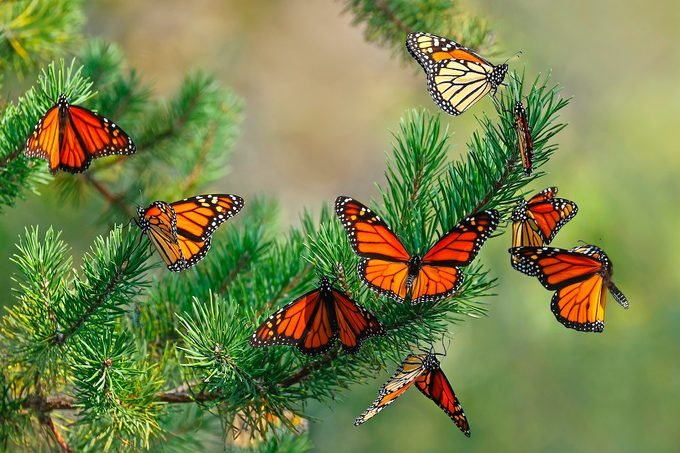
The International Union for the Conservation of Nature (IUCN) added the migrating monarch butterfly for the first time to its “red list” of threatened species and categorised it as “endangered” — two steps from extinct. This comes after scientists say that the population of monarch butterflies in North America has declined between 22% and 72% over 10 years with a shocking drop in numbers of between 85% and 95% since the 1990’s.
“What we’re worried about is the rate of decline,” said Nick Haddad, a conservation biologist at Michigan State University. “It’s very easy to imagine how very quickly this butterfly could become even more imperilled.”
In North America, millions of monarch butterflies undertake the longest migration of any insect species known to science. After wintering in the mountains of central Mexico, the butterflies migrate to the north, breeding multiple generations along the way for thousands of miles. The offspring that reach southern Canada then begin the trip back to Mexico at the end of summer. It is a true spectacle and incites such awe.
Monarchs can travel between 50-100 miles a day and can take up to two months to complete their journey. The farthest ranging monarch butterfly recorded travelled 265 miles in one day. Monarch butterflies cluster in tree tops at the El Rosario Monarch Butterfly Preserve in Central Mexico Coast in Michoacan, Mexico.
A smaller group spends winters in coastal California, before dispersing in spring and summer across several states west of the Rocky Mountains. This population has seen an even more precipitous decline than the eastern monarchs, although there was a small bounce back last winter.
Emma Pelton of the non-profit Xerces Society, which monitors the western butterflies, working with the US government, said the butterflies are imperilled by loss of habitat and increased use of herbicides and pesticides for agriculture, as well as climate change.
By planting milkweed, a plant that the caterpillars depend upon in gardens and forests, humans can perhaps stall the further decline and extinction of another iconic species as man’s footprint on earth create additional damage.
Non-migratory monarch butterflies in Central and South America were not designated as endangered. The United States has not listed monarch butterflies under the Endangered Species Act, but several environmental groups believe it should be listed.
Some good news
The IUCN also announced new estimates for the global population of tigers, which are 40% higher than the most recent estimates from 2015.
The new figures, of between 3,726 and 5,578 wild tigers worldwide, reflect better methods for counting tigers and, potentially, an increase in their overall numbers, said Dale Miquelle, co-ordinator for the non-profit Wildlife Conservation Society’s tiger program. In the past decade, tiger populations have increased in Nepal, northern China and perhaps in India, while tigers have disappeared entirely from Cambodia, Laos and Vietnam. They remain designated as endangered.
The International Union for Conservation of Nature (IUCN) is a membership Union uniquely composed of both government and civil society organisations. By harnessing the experience, resources and reach of its more than 1,400 member organisations and the input of some 15,000 experts, IUCN is the global authority on the status of the natural world and the measures needed to safeguard it.