
Trees have been relied on to control the devastating effects of global warming. However, it may not be the case that forests are the ultimate climate saviours and new research may prove otherwise.
While governments are vocal about their good intents, little progress had been made in controlling their carbon emissions. Planting trees seemed to be the saving grace of the Earth, but it may not be to such an extent as everyone had hoped.
Forest’s big 2015 Paris Climate Accord Boost
Forest schemes received a major boost from the 2015 Paris climate treaty which showed global efforts to offset carbon emissions from fossil-fuel use and other sources by planting or protecting forests. China, with its heavily polluted air, undertook to plant trees over an area up to four times the size of the United Kingdom. California’s forest owners and other American states were considering similar programmes. The European Union (EU) agreed to allow countries to include forest planting in their plans to fight climate change, while other EU nations pledged billions of dollars to tropical forest programmes.
A mix of Heat and Cooling
While many scientists applauded the expansion of forests, some are urging caution, claiming forest have more-complex and uncertain climate impacts than policymakers, environmentalists and even some scientists acknowledged, to date.
It is indeed true that trees cool the globe by taking up carbon through photosynthesis, but they also emit a complex mix of chemicals adding to global warming; dark leaves of trees can also raise temperatures by absorbing sunlight. Several analyses over the past few years suggest that these warming effects from forests could partially or fully offset their cooling ability.
Data Collection Drives
This had prompted vigorous debate among scientists about how forests in different regions have warming or cooling effects. Nobody denies that trees are good for the environment with forests providing a host of benefits and harbour much of the world’s terrestrial biodiversity. Researchers are NOT suggesting cutting down existing forests or curtailing efforts to combat deforestation. However as governments, corporations and non-profit organisations embark on more ambitious programmes to slow climate change, some scientists warn against relying on forests as a complete solution to global warming.
Globally, researchers are involved in various campaigns to collect data using aeroplanes, satellites and towers in forests to sample the full suite of chemicals trees emit, which can affect both climate and air pollution. At the same time, some researchers worry about publishing results challenging the idea that forests cool the planet. One scientist even received death threats after writing a commentary arguing against planting trees to prevent climate change.
“When it comes to forests and their ability to cool the climate, there are a lot of misstatements or overplaying of what can be done.” – geo-scientist, Gordon Bonan
The questions are multiplying as more scientists enter the debate. “People want an answer; they want to be able to say, ‘this is what we should do’,” says Gordon Bonan, a geoscientist at the National Centre for Atmospheric Research in Boulder, Colorado.
Carbon sponges
If tree-planting programmes work as heralded, they could indeed buy precious time for the world to reduce its reliance on fossil fuels and replace them with cleaner sources of energy. One widely cited 2017 study estimated that forests and other ecosystems could provide more than one-third of the total CO2 reductions required to keep global warming below 2 °C through to 2030.
Although the analysis relies on many big assumptions, such as the availability of funding mechanisms and political will, its authors say that forests can be an important stopgap while the world tackles the main source of carbon emissions – the burning of fossil fuels. “This is a rope that nature is throwing us,” says Peter Ellis, a forest-carbon scientist at The Nature Conservancy in Arlington, Virginia, and one of the paper’s authors.
The background
In the 1780’s Swiss pastor, Jean Senebier, grew plants under different conditions and showed for the first time that plants absorb CO2 from the air. More than two centuries later, Senebier’s insights form a key component of plans to combat the accumulation of CO2 in the atmosphere.
The rationale still is that trees can lock up carbon in their wood and roots for decades or even centuries. The 1997 Kyoto Protocol climate treaty allowed rich countries to count carbon storage in forests towards their targets for limiting greenhouse-gas emissions, but few did so because of the agreement’s unwieldy accounting mechanisms and other factors.
Later negotiations laid out a framework for enabling wealthy countries to pay poorer tropical countries to reduce emissions from deforestation and to increase carbon in forests. The framework was formalised under the 2015 Paris agreement, requiring countries to commit to reduce greenhouse-gas emissions and more than 50 nations pledged to add tree cover or protect existing forests.
So where are these trees?
In the graph below taken between 1982 and 2016, tree spots are shown.
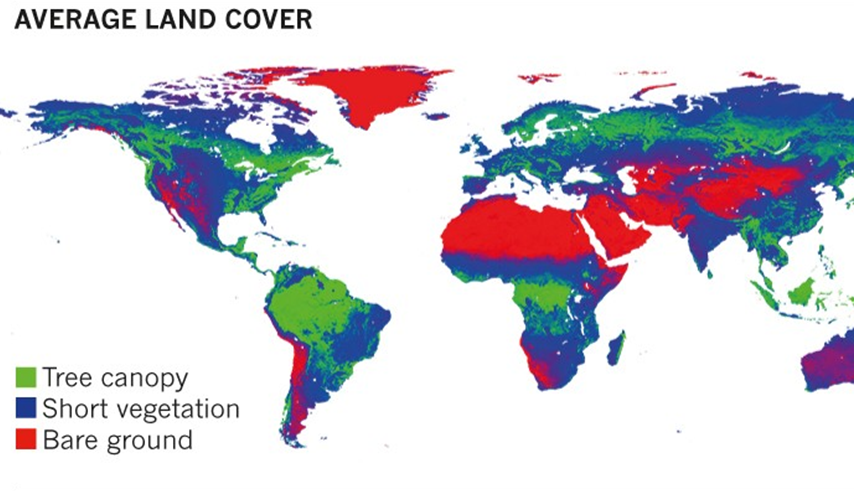
However, in graph 2, a different picture emerges
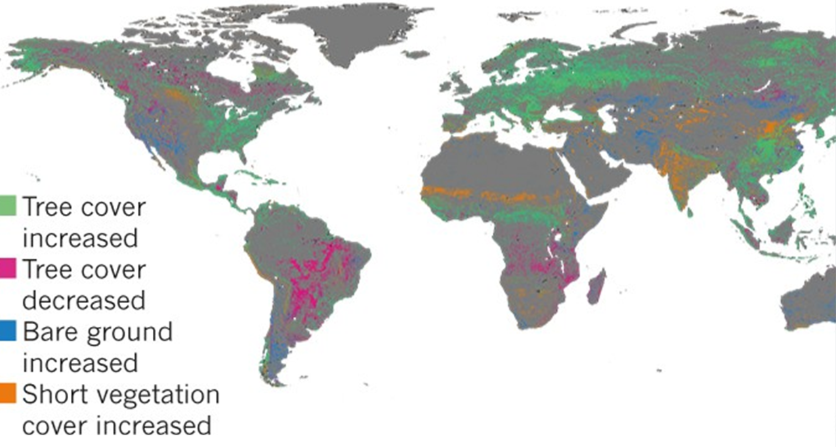
Source: X.-P. Song et al. Nature 560, 639–643 (2018)
In 2011, an international group of researchers at the US Department of Agriculture’s Forest Service concluded that forests globally are a large carbon sink, taking more carbon out of the air through photosynthesis and wood production than they release through respiration and decay.
That does not mean all forests cool the planet, however. Researchers have known for decades that tree leaves absorb more sunlight than do other types of land cover such as fields or bare ground. This means that the planet reflects less incoming sunlight back into space, leading to global warming. This effect is especially pronounced at higher latitudes and in mountainous or dry regions, where slower-growing coniferous trees with dark leaves cover light-coloured ground or snow that would otherwise reflect sunlight. Most scientists agree, however, that tropical forests are clear climate coolers with trees there growing relatively fast while transpiring massive amounts of water forming clouds; two effects helping to cool the planet.
Recent Studies and Conflicting Opinion
More-recent studies have included other ways in which forests can influence climate. As trees live, grow and die, scientists have learnt, they are in constant conversation with the air, swapping carbon, water, light and a bewildering array of chemicals interacting with the climate.
Atmospheric chemist, Nadine Unger, then at Yale University in New Haven, Connecticut, conducted one of the first global studies examining one part of this exchange – volatile organic compounds (VOC’s) emitted by trees. These include isoprene, a small hydrocarbon that can warm the globe in several ways. It can react with nitrogen oxides in the air to form ozone, a potent climate-warming gas when it resides in the lower atmosphere. Isoprene can also lengthen the lifetime of atmospheric methane, another greenhouse gas. Yet isoprene can have a cooling influence as well by helping to produce aerosol particles blocking incoming sunlight.
Unger ran an Earth-system model that estimated the effects of chemical emissions from forests. Her results suggest that the conversion of forests to farmland throughout the industrial era might have had little overall impact on climate. Clearing forests liberated carbon stored in trees, but increased Earth’s albedo (leading to cooling) and decreased emissions of VOC that can both cool and warm. She followed up on her research paper by writing an opinion piece in TheNew York Times – ‘To Save the Planet, Don’t Plant Trees’ – which argued that the large uncertainties around the extent to which forests cool or warm the climate made tree planting a risky strategy for fighting climate change. The article and especially the headline (which Unger did not write), triggered a tsunami of complaints from researchers who disputed the science and said the piece threatened to undermine years of research and advocacy.