
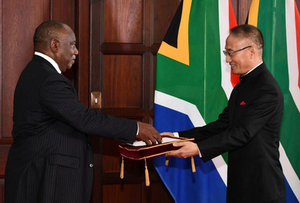
On the cusp of the 25th anniversary of China-South Africa bilateral relations, this year’s China Open Day showcased the results of green belt and road cooperation between the two countries.
When China’s ambassador to South Africa Chen Xiaodong told a large gathering of students at China’s Open Day event in Sandton that the belt and road journey of China to South Africa had laid the foundations for sustainable cooperative relations between the two countries, there was a striking undertow of historical kinship and pragmatism in his message. “If you want to go fast along a journey, go alone,” he said. “If you want to go far, go together.”
While there was no handbook for the energetic passion behind China’s mission in South Africa, Xiaodong’s remarks resonated with an evolving story of hope and success – one that was particularly relevant to this year’s Open Day theme: ‘Building a bridge to the future’. It is a story told by Deswan Basson, a new employee of China Energy’s South African subsidiary Longyuan SA, who’s perseverance against incredible odds ranges the passions and ingenuity of China’s investment in renewable energy in South Africa.
Born to unemployed parents in an impoverished township in the Northern Cape, Basson dreamed of being an engineer as a high school student. After finishing school, he found work at Longyuan’s solar farm in De Aar during its construction phase. “The salary I earned gave me an opportunity to complete my N2 in engineering at Technikon,” he said. “I was then accepted into Longyuan’s bursary programme, which made it possible for me, with the added assistance of in-service training at Longyuan to study fulltime and graduate.”
Today, Basson’s success story – from humble beginnings in a ruinous swathe of deprivation and hopelessness in the Northern Cape to a skilled engineer at Longyuan’s De Aar Wind Power Project – is what Xiaodong called an exemplar of “shared prosperity and cooperation” grounded in pragmatic relations between the two countries and their peoples. “The model of cooperation between the two countries shows not only our effective cooperation in the transition to a low carbon and green economy, it also demonstrates China’s commitment to sustainable development in communities,” said Xiaodong.
Longyuan SA, a subsidiary of the world’s largest wind power developers, China Longyuan and China Energy, can boast an impressive R5 billion wind power project investment in the Northern Cape, totalling 244.45MW that powers 300 000 households with clean, affordable energy and is a source of livelihoods to locals like Basson.
Impelled to think pragmatically about shared prosperity, there was never to be found in China’s repertoire of goals, joint chairman of South Africa’s steering committee on climate change Cedric Frolick told the gathering, “the asymmetries that exist between developing countries and (Western) developed countries, where those countries at the top of ladder want to stay at top”. “South Africa and China share a common history of struggle against oppression and imperialism,” he said, adding: “Building cooperation, in that sense of history and shared ambitions, is an ongoing task of mutual benefit between the two countries that began as a modernising mission in 1998 when China and South Africa officially set out on a journey as strategic partners premised on the principle of shared prosperity.”
Just Energy Transition
If this was the thinking that marked the 25th anniversary of formal diplomatic relations between the two countries, it was a sentiment that gelled with Frolick’s concluding remarks: “Mindful of commitments by Western countries and multilateral institutions, the reality is that these commitments seldom see light of day. As such, it is important for China and South Africa to continue working together and do what’s important in terms of our own development trajectory,” he said.
“Against the intentions of developed countries, whose investments in developing countries have caused the greatest damage in terms of climate change, we must continue working with partners in the same position as us around new interventions rooted in the Just Energy Transition and green economy,” he added.
The timing of the two declaratives at the event – of a Just Energy Transition and green economy – carried a stark symbolism and opportunity for China-South bilateral cooperation around the transition to a carbon-neutral economy. In his address to the gathering, South Africa’s ambassador to China, Siyabonga Cwele, said South Africa’s recently released Just Energy Transition investment plan presented practical economic challenges, not least of which was the need for $80 billion in green economy investments over next five years to enable a just transition. “This is an opportunity for China in South Africa,” said Cwele. “Our government is improving the energy transition by utilising climate change funding and accelerating and scaling up investment in renewables as part of our energy mix. Chinese companies have a distinct advantage because of their advanced and affordable green technologies.”
The unfortunate by-product of the just transition, Cwele said, may be employment casualties in fossil fuel sectors, but the economic spillover and employment multiplier effects were considerably more promising than the current fossil fuel-based economy. “Studies show that green energy produces more jobs than fossil fuel-based industries, although there may be a gap in transition,” he said. “This gap must be filled in terms of skills. China has good training institutions and is partnering with South Africa in the provision of such skills.”
Longyuan SA – a role model for investment
Perhaps the most tangible achievement of this bilateral approach to the energy transition is Longyuan SA’s Wind Power projects in the Northern Cape. On 29 October 2013, the Department of Energy of South Africa announced that Longyuan South Africa Renewables successfully won two wind power projects, De Aar 100.5MW and De Aar II 144MW, respectively, in the Northern Cape, with the total investment worth over R5 billion. The windfarms are vast fields of turbines that turn quietly. There are no carbon emissions – in contrast to coal-fired plants which it’s replacing.
The infrastructure and investment required to scale up wind farms do not come cheap, but the expense pales by comparison with the benefits to the economy, livelihoods and the environment, Xiaodong said. Longyuan’s project takes the form of several turbines in vast wind farms: their assembly and installation belie the fact that they’re done in partnership with local contractors and expertise under the expert guidance of Chinese expertise.
“It is invested, operated and built by China’s independent power producers,” said Xiaodong. “As well as playing an important role in South Africa’s energy transition, the Lonyuan wind power project also undertakes social responsibilities, procuring local equipment, local design, employment of local employees as well as the establishment of local community funds to contribute to the development of communities where projects are located.”
In a country facing multiple power cuts, every day, because of an energy shortage and an area as poor as the Northern Cape, that’s a real game-changer. Two big problems – poverty and climate change – tackled with one solution: renewable energy.
Five of the area’s regions now boast wind farms, either in operation or under construction, and their effect has been dramatic. The local community is understandably proud of the project: it is a large oasis of hope in the heart of a desolate landscape. Hailed as a model of clean energy cooperation among BRICS, the project integrates investment and construction and has assisted the domestic equipment, technology and services sectors; technical exchanges and cooperation; and has promoted community development.
Belt and road cooperation
What is centrally important, said Xiaodong, is that the De Aar wind power project is the first in Africa that integrates investment cooperation and China’s green belt and road initiative. “Beyond investment, it is a role model of pragmatic cooperation. It demonstrates the win-win relationship between China’s competitive advantage in affordable clean energy solutions and South Africa’s superior geographic location as an important bridge between China’s belt and road and Africa’s strategy,” he said.
Since the onset of formal diplomatic ties between the two countries in 2008, South Africa has been one of the largest investment destinations for Chinese companies in Africa. “By the end of 2021, a total $25 billion dollars was China’s investment in South Africa,” said Xiaodong. In his address, China Energy chairman Wang Xiangxi added: “China has 190 members composed of Chinese companies in South Africa covering all sectors of the economy with a total 100 000 jobs having been created. We estimate a total R50 billion in total investments aimed at development projects in historically disadvantaged communities in South Africa.”.
Results such as these are a model of investment, but with a difference: both China and South Africa share the spirit and practice of BRICS and the belt and road initiative.
“We have set great example for cooperation in renewable energy and green economy investments,” said Cwele. We support the view that the path to modernisation is peaceful and cooperative development. And we are committed to walking with China on a path to peaceful development towards shared prosperity. Along this journey, it is important for our youth to be part of this shared commitment. You can see the hope of people-to-people development in De Aar.”
Indeed, an impassioned presentation by Mzi Fani, a young South African computer engineering graduate, at the end of the gathering was bristling testimony to the resilience of the evolving China-South Africa bilateral landscape. “When I was in China I was intrigued by mega structures, including wind farms. When in South Africa I visited the wind farm in De Aar, I was struck by how clean the plant was. After spending time in the control room and visiting the large turbines, I visited communities in De Aar. I saw sport fields, beneficiaries of bursary schemes, well maintained and beautiful creches, food sponsored by Longyuan.”
SIDEBAR
South Africa – Ripe for investment
“Due to a history where South Africa had energy preserved for a white minority, we have faced a challenge since 1994 of broadened access to the majority of people. And with the transition, Eskom today faces huge challenges of energy supply.”
With these words, University of Johannesburg Centre for China-Africa Studies director David Monyae called on China to play a critical role in tackling the challenges of clean energy supply, poverty, unemployment and inequality. “South Africa is largely dependent on coal for its energy production,” he said. “This is a finite resource and emits toxic gases which is a danger to the environment. This calls for alternative energy.”
What is important in solidifying ties between China and South Africa, he said, is that “South Africa is strategically endowed with sources of renewable energy. The country has a goal to drive an energy mix under government’s Independent Power Producer procurement programme. In that sense, the South African government envisages lots of projects for IPPs. Chinese companies wanting to invest in South Africa have a lot of opportunities.”
Monyae emphasised the Department of Mineral Resources and Energy’s transition towards clean energy and climate goals, saying “companies will receive better preferences if they include local Black Economic Empowerment companies. Their commitment to corporate social responsibility is another advantage. As Africa’s most industrialised economy, it is therefore important that our relationship with China is built around the opportunities for investment in South Africa and the knowledge of Chinese companies in ensuring that we overcome loadshedding and the challenges of poverty and inequality.”
SIDEBAR
China – Pioneering affordable technological innovations
“China is ready to work with South Africa and to deepen cooperation. We look forward to promote pragmatic relations between the two countries and building of a community of shared futures.”
When China Energy chairman Wang Xiangxi made these remarks via Zoom to the Open Day gathering in Sandton, he was advancing China Energy’s competitive advantage as a technological innovator of affordable products in the renewable energy market.
“The China Energy group is one of largest suppliers globally of clean energy solutions and a global leader in many fields,” he said. “The group has established a development strategy of value-based production that we strive to implement in pursuit of President Xi Jinping’s mission of position us as a leading energy company and contributor to building the green belt and road initiative.”
“In South Africa, our subsidiary Longyuan SA is a showcase of our pioneering role in renewables. It is a role model that we will strengthen and replicate in our drive to build green energy cooperation, adhering all the while to the principle of sincerity and openness as we bridge the connection between the two countries.”