
By taking advantage of assembly line production, SMRs promise cost reductions and shorter construction times relative to their conventional counterparts. The first nuclear small modular reactors (SMRs) are already operational in Russia and China, but widening adoption will require both technical and regulatory developments, including development in fuel supply chains and international licensing standardization.
Cheaper and Safer
Nuclear SMRs hold the promise of bringing nuclear power into a new age by cutting costs while improving safety. These nuclear reactors, usually with an electrical capacity of less than 300MW and largely built on assembly lines, are expected to compete to provide baseload and demand-following grid capacity with intermittent renewables and energy storage as decarbonization efforts intensify. Furthermore, they could directly provide process heat to emissions-heavy industries, including steelmaking, alongside electricity generation. They could even reuse existing infrastructure at the sites of old nuclear or fossil fuel power plants, cutting the cost and impact of providing new grid capacity.
Adoption Roadmap
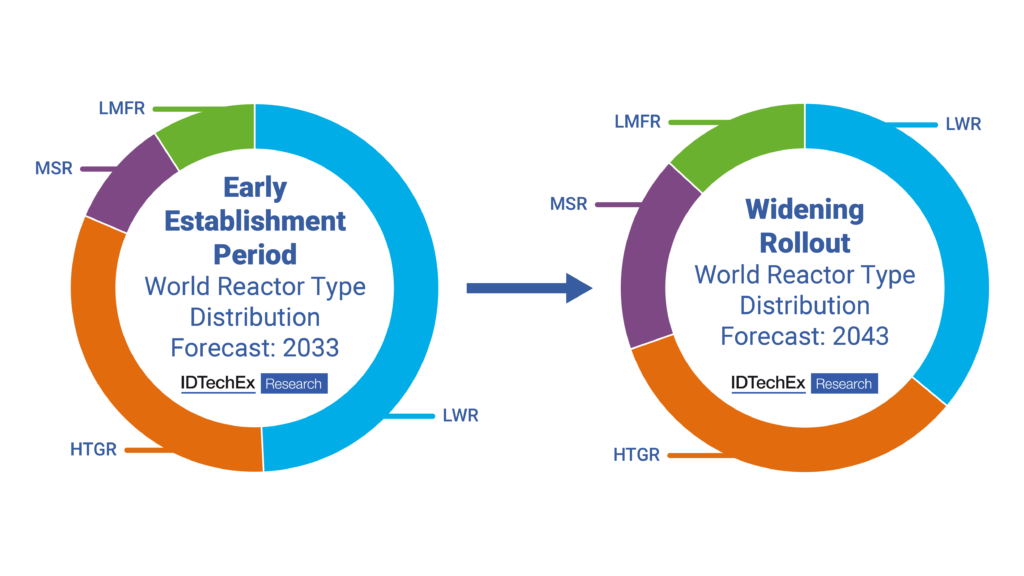
While SMRs are largely evolutions of existing nuclear fission technology, this does not mean that the nuclear industry can immediately transition to connecting them to the grid in great numbers. Drawing on analysis of government policies, the stated goals of SMR designers, data-based benchmarking, and more, the 20-year market forecast from a recent IDTechEx report predicts the next decade to be one of establishment for SMRs, with early demonstration reactors built to prove commercial feasibility and gain operational excellence. The next decade to 2043, however, is expected to be high-growth, as rollout widens and a commercial fleet of SMRs takes place globally.
But why these two distinct periods? For one, there’s the build time of the reactors themselves. SMRs tend to simplify reactor designs compared to their large counterparts. For example, many designs circulate coolant via natural convection without the need for turbopumps, which also increases the level of passive safety of the design. Modularization and the use of pre-fab building elements help costs. Both factors should speed up build time: for example, GE-Hitachi’s BWRX-300 SMR should take 2-3 years to build, with other SMR designers stating similar timeframes. This compares to a mean construction period of around 8 years for large reactors.
Despite these increased efficiencies, when building a fleet of a new reactor design the first few reactors of a fleet will likely constitute a proving force before a wider nth-of-a-kind rollout takes place, meaning that the real-terms lead time from the first of a fleet to series production is closer to the order of at least. As proving occurs, the factory infrastructure for building the plants must expand. This is emblematic of the supply chain expansion, another factor slowing down the initial rollout of SMRs, for specialized fuel types on top of the reactors themselves. Efforts are already in place to solve this, including the US Government making US$700M of funding available to support the production of the HALEU (High Assay Low Enriched Uranium) fuel used by many advanced SMR designs.
Standardized Licensing
The licensing process for nuclear reactors is famously long-winded, ensuring safety is a key priority. These long and capital-intensive processes are one of the strongest factors delaying the initial build of SMRs. Still, there may be ways to speed up these processes without compromising safety. Increasing the transferability of approval between individual sites and even internationally would prevent duplication of work and the latter factor would work in favor of the export potential of SMRs, which is often a key rationale behind their designs. The International Atomic Energy Agency’s (IAEA) Nuclear Harmonization and Standardization Initiative aim to provide a framework to improve the compatibility of international regulatory processes to prevent a repetition of work between countries, particularly focusing on SMRs. It could be envisioned that the licensing system eventually follows more closely to that of airliners, with a highly safety-critical industry having a well-agreed-upon regulatory process internationally.
The expected high growth rate of SMR builds from the mid-2030s onwards is indicative of the impact these technologies could have on solving the climate crisis. As existing nuclear and even coal-fired power plants come offline, SMRs have the potential to take their places in the grid as a low-carbon power source while minimizing the impact of constructing new capacity on communities.
Comprehensive Insight
IDTechEx’s report “Nuclear Small Modular Reactors (SMRs) 2023-2043” provides comprehensive coverage of the SMR space. It provides twenty-year market forecasts, benchmarking of SMR designs, application suitability analysis, dissection of the industry landscape, and more, making it essential reading for anyone wishing to understand this emerging low-carbon energy source. Further details on the report, including downloadable sample pages, are available at www.IDTechEx.com/SMRs.
To find out more about IDTechEx’s technical and commercial analysis of the SMR industry and our extensive portfolio of detailed market research across a wide range of emerging technologies, please contact research@IDTechEx.com.