According to 2020’s statistics, the South African (SA) beef farming industry accounts for approximately 4.5% of the total greenhouse gas emissions in the country, an important indicator of how much work this industry has to do to change its footprint to address climate change. In SA, agriculture comprises a small portion of the total emission load, 5.5%, with beef farming contributing approximately 4.5% to this total.
This industry forms the backbone of SA’s agricultural landscape, driven by the high demand for quality beef and related products. Only the promotion and adoption of innovative and sustainable cattle farming practices would be able to reverse the trend towards a more sustainable future.
Changing the Face of Beef Farming
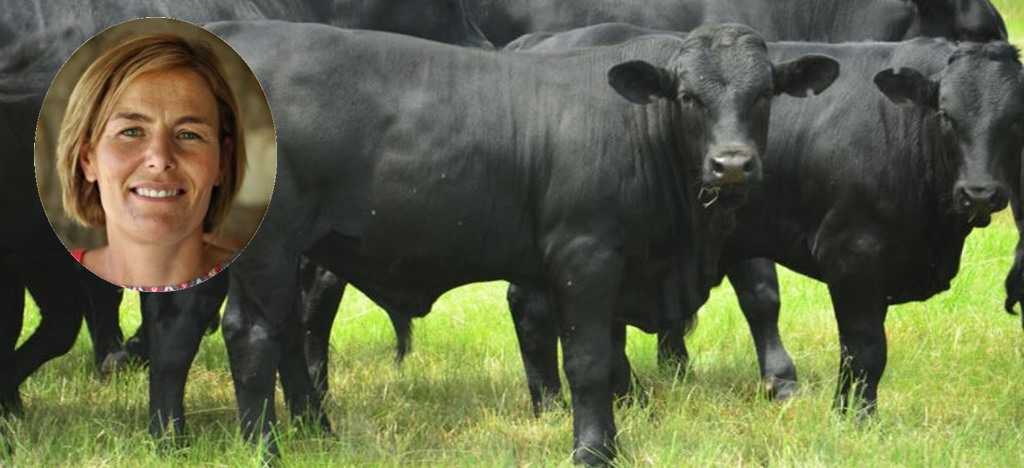
Although the industry is predominantly associated with elderly white males, it is gradually transforming as more young women are taking up commercial beef farming. Among them is Dr Liesel Ann Foster, a successful commercial beef cattle farmer from Quaggafontein Farm in the small town of Zastron in the Free State.
Future-proofing the Industry against Climate Change
Dr Foster was raised assisting her father with a range of daily garden and farm activities. This exposed her to the outdoors and prepared her for a future in farming. She studied at two highly regarded colleges, the Potchefstroom Agricultural and Glen Agricultural to learn how to manage cattle and sheep farms. She also studied the latest innovative ways through which the industry can sustain and future-proof itself against climate change.
In 2007, Dr Foster obtained a BTech degree in agriculture (cum laude) at the Central University of Technology (CUT) in the Free State. This was followed by an MTech degree in agriculture and she capped her academic achievements with a PhD in 2010 with the focus of her doctorate research on: “The profitability and production of a beef herd on transitional Cymbopogon-Themeda veld with three different levels of lick supplementation”. She researched the effects of three different levels of lick supplementation and the effects on the production and profitability of a beef herd kept extensively on a mixed veld.
Awards and Accolades
In 2003 she started to farm independently and within a very short period became one of the most successful young female farmers in the commercial beef industry in and around the Free State province, beef farming with Drakensberger cattle, a SA breed known for milk production and meat. She also owns the Quaggafontein Drakensberger Stud and Dohne Meat master-cross sheep. Her success saw her receiving several accolades which included:
- Being selected as a finalist in the Agricultural Research Council’s Beef Cattle Improvement Herd of the Year competition for the Free State region in 2005 and 2006, as well as from 2008 to 2010;
- Third place in the Free State Department of Agriculture’s Female Farmer of the Year competition in 2009 for producers who supply beef to national markets and
- Receiving a Gold Award in the Elite Beef Farmer of the Year competition and a Silver Award in 2012 and 2013, as well as in 2014 and 2015.
Continuing Research and Leading the Way
Dr Foster was one of the beneficiaries of CUT’s Stars of Academe and Research (SoAR) fellowship programme for post-graduate studies. She joined the programme in 2011 and enrolled for a DTech degree in agriculture after deciding to use this once-in-a-lifetime opportunity to further investigate further methods of increasing the profitability of beef cow or calf production systems in the Free State.
CUT’s “Grow-your-own-timber”programme saw a bevy of highly qualified and talented students entering the university’s academic and research community. The main objective of the programme is to contribute to socio-economic development in the region. It also aims to increase the critical mass of young, outstanding black female academics, particularly in scarce and critical skills.
In addition, it encourages outstanding candidates to pursue academic careers across various areas of scientific research, teaching and technological development and science, engineering and technology. It also creates and supports, promotes and sustains excellence in scientific and technological teaching and research. It also promotes academic careers for young black women.
Dr Foster had not only made her mark as an outstanding farmer with vision, but has paved the way for other female farmers to challenge the status quo and thereby, benefit the planet.