
What are the causes of biodiversity loss?
The latest Living Planet Index (lpi) from the World Wide Fund for Nature (WWF), has been published. It tracks populations of mammals, birds, fish, reptiles and amphibians and the new issue reveals an average 69% decrease in monitored wildlife populations since 1970. The 2022 lpi analysed almost 32,000 species populations, providing the most comprehensive measure of how they are responding to pressures in their environment.
The world is waking up to the fact that our future depends on reversing the loss of nature just as much as it depends on addressing climate change and you can’t solve one without solving the other. Everyone has a role to play in reversing these trends, from individuals to companies to governments.
Carter Roberts, President and CEO of WWF-USA
Freshwater Populations Hit the Hardest
Monitored freshwater populations have declined by an average of 83% since 1970, more than any other species groups. Habitat loss and barriers to migration routes account for around half the threats to these populations.
Life on Earth is Under Threat
Biodiversity, the variety of life on earth, provides us with services essential for human well-being such as clothing, food, and medicines, but we are losing it at an alarming rate.
A million plant and animal species are threatened with extinction; we have lost half of the world’s corals and are losing forest areas the size of 27 football fields every minute.
Coral Reefs and Its Benefits for Humans
Coral reefs cover less than 0.1% of the ocean floor, but are home to a quarter of all the marine species on earth. This makes them incredibly biodiverse ecosystems, supporting a complex food web of organisms that includes humans.
Around 850 million people around the world are thought to rely on coral reefs for their food and livelihoods. Healthy reefs directly support around 30 million small-scale fishing jobs. Reef tourism is a £36 billion industry, providing work for thousands of people in some of the world’s poorest countries.
As well as helping to fill our bellies, reefs also feed our souls. They are central to the cultures of many indigenous people and a source of wonder for all of us who love the natural world. Coral extracts are increasingly being used to improve our physical well-being too, providing treatments for asthma, arthritis, cancer and many other diseases.
These huge living structures even provide humanity with a physical barrier from harm. Research has shown that coral reefs reduce wave energy by as much as 95%, giving coastal communities vital protection from tsunamis and storms. In short, the importance of our coral reefs is enormous. unfortunately, so are the threats they face.
Why Should We be Concerned?
The earth has warmed by an average of 1.2°c since pre-industrial times and in the last 40 years we have lost 50% of our coral reefs. If average global temperature rises by 1.5°c, the loss will be somewhere between 70% and 90%. In a world with 2°c of warming, only 1% or our coral reefs will remain.
Fundamental Importance of Forests
Forests stabilise our climate and without them, global temperatures would be 0.5°c higher. Every year we lose forests about the size of Portugal (92,152 km²) Deforestation causes carbon emissions, increases droughts and leads to warmer, drier local climates. It also puts the food security and livelihood of millions of people at risk.
Biodiversity Loss by Region
According to the Ipi, the biggest loss (94%) is in Latin America and the Caribbean, followed by Africa (66%) and the Asia-Pacific (55 %.) North America and Europe-Central Asia show a loss of 20% and 18%, respectively.
Why are We Losing Nature?
Biodiversity is fundamental to our health, well-being and economic success. It is essential to understand why nature is in decline in order to alter this path. Five key drivers of biodiversity loss have been identified by the intergovernmental science-policy platform on biodiversity and ecosystem services (ipbes). These are changes in the use of sea and land, direct exploitation of organisms, climate change, pollution and invasive non-native species.
Bending the Curve to Reverse Nature Loss
There are many ways in which we can reverse nature loss which include bolder and more ambitious conservation efforts. However, we also need transformational changes in the way we produce and consume, such as making food production and trade more efficient, reducing waste and favouring healthier and more sustainable diets.
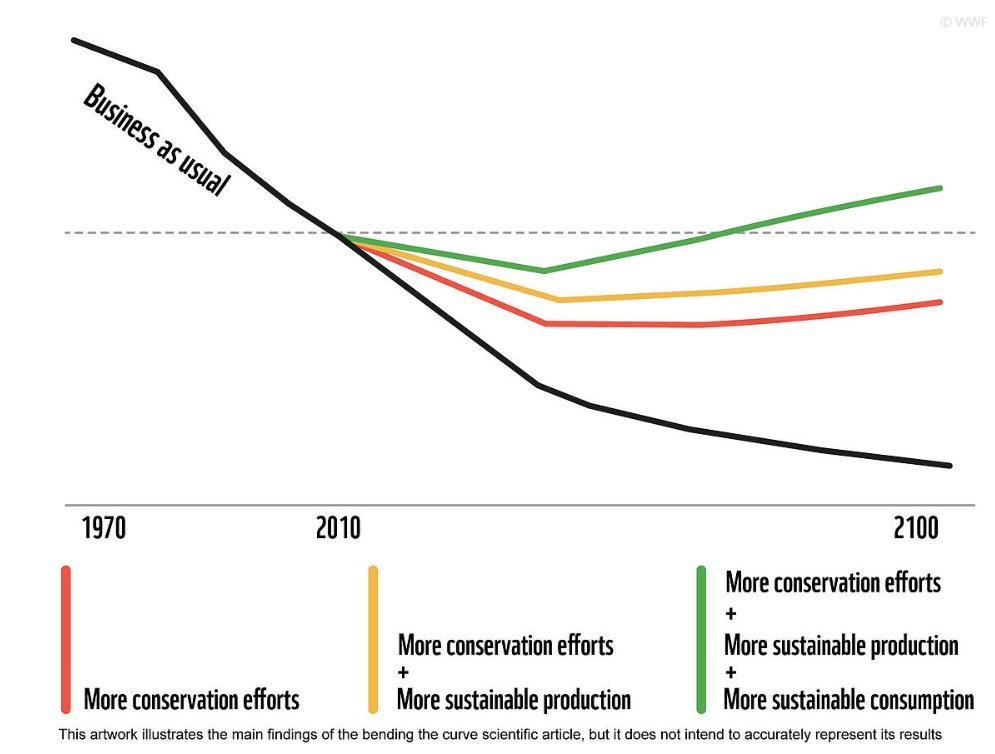
(Graph: WWF)
Cutting-edge modelling shows that without further efforts to counteract habitat loss and degradation, global biodiversity will continue to decline. But, it also shows that we can ‘bend the curve’ of this unwelcome trend and begin to stabilise and reverse the loss of nature so that there is more nature in the world than there is now. It requires more conservation efforts, more sustainable production, and more sustainable consumption. None of these actions alone are enough. Only when all three actions are taken together will we see the reversal of nature loss at the speed we need.