
Justin Platt, Founder & CEO, Zylem and RegenZ
Growing Food
Let’s talk about how we grow our food. There’s a bit of a debate going on between two ways of doing things.
On one side, there’s the traditional farming method using a lot of chemicals to grow crops. There is a concern that changing how we farm might mean not having enough food for everyone. On the other side, there’s a different approach – conservation farming. This method believes in using fewer chemicals and taking better care of the land. I believe this second way could be the game-changer we need, especially when we look at the different types of farmers and how they work.
But my opinion isn’t shared by everyone. The large commercial farming operations, which are currently producing most of the world’s wheat, rice, potatoes, maize, etc., together with the fertiliser and pesticide companies, are clearly of the opinion that conservation agriculture, which targets a considerable reduction in inorganic fertiliser and pesticides, is a fringe food option.
Conservation Farming is About Four Simple Ideas
- Minimal soil disturbance
- Soil armour through mulch or cover crops
- Crop diversity
- Livestock integration
Smallholder Farming
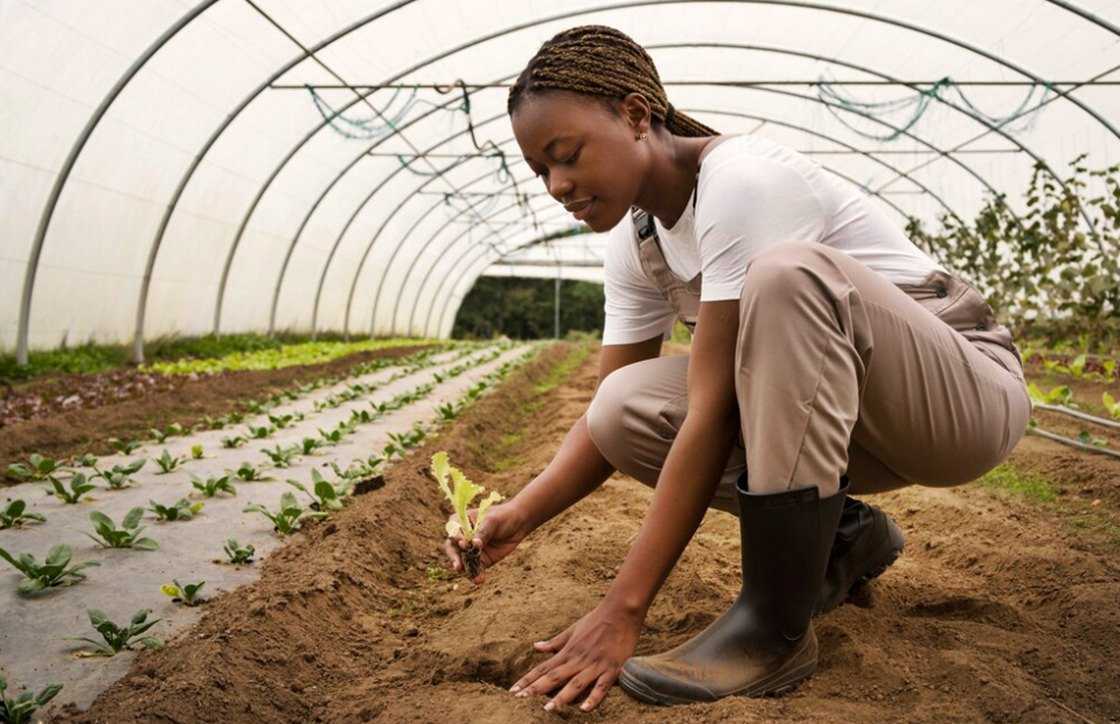
These ideas are already used by smaller farmers by default because they cannot afford expensive chemicals. This means their land is healthier and not damaged by chemicals and pesticides and will hopefully stay that way if smallholder farmers get appropriate guidance that will retain the soil’s natural integrity before it is affected due to bad advice!
At the moment, little to no investment is being made in the smallholder farmer industry by large plant breeding companies and fertiliser/pesticide suppliers because it is too fragmented, too impoverished and almost impossible to capture. With some science, management, and conservation agriculture knowledge, smallholder farmers’ land can be very productive and capture far greater carbon volumes. What smallholder farmers do need, however, are viable markets.
In South Africa, there are huge commercial farms covering about 46.4 million hectares. But there are also smaller farmers, around 2.5 million of them, who work on a smaller area. Currently, it’s the 40,122 commercial farms that are producing 90% of the national food supply.
Data from the FAO in 2014 paints a different picture on a worldwide scale. Across the globe, more than 90% of farms are run by an individual or a family. These farms occupy around 70-80% of farmland and produce more than 80% of the world’s food in value terms.
It’s clear that smaller farmers have some real potential, especially with crops such as potatoes (the third biggest crop in the world). If they could improve how much they grow, they could actually supply enough potatoes for everyone, both for processing and for our tables. I think it’s realistic to say that smallholder farmer potato growers can double their yields from their current +-10T/ha.
And if smallholder farmers are already farming without expensive inputs, it is not inconceivable that commercial farmers with more resources (genetics, training and logistics) could do the same.
New Technology That Could Change the Game
Solynta is one of the first companies targeting the smallholder farmer sector with Hybrid True Potato Seed (HTPS)—a great example of new technology that will challenge the dinosaurs and their strongly vested interests. As genetics are established in the next five years, we could be staring down a game-changing solution.
The potential of HTPS include
- Increased efficiency: Traditional potato farming relies on tubers for propagation, which can be bulky and susceptible to diseases. HTPS allows for easier transportation, storage and distribution compared to tubers. This efficiency saves space and resources.
- Disease resistance: breeding hybrids (diploid) can lead to the commercialisation of new disease resistance and other traits faster, i.e. 18 months vs. 12 years.
- Genetic diversity: Traditional (tetraploid) breeding, while also introducing desired traits, depends on clonal propagation prior to commercialising.
- Cost reduction: Using HTPS can potentially reduce costs associated with storing and transporting traditional tubers. It also allows for easier distribution across regions and countries, potentially improving global access to diverse potato varieties.
So, can conservation agriculture feed the world?
In one study, conducted on farms in the Northern Plains of the USA, researchers found that crop yields decreased by approximately 29% in regenerative systems. However, the profitability of such farms skyrockets by a staggering 78% compared to conventional plots. This surge in profitability owes itself to decreased input costs, notably in terms of fertilisers and the diversified income streams offered by regenerative products commanding higher premiums in the market. These findings challenge the traditional emphasis solely on yield metrics and underscore the importance of soil health and organic matter in determining farm profitability.
However, it’s worth noting that this was a much localised study. While regenerative methods can lower yields, the numbers vary greatly depending on the crop and local conditions. In some cases, regenerative and organic methods can lead to similar yields and even yield increases.
So maybe conservation agriculture can’t feed the world entirely, but it definitely offers a smarter way of growing food and creates a healthier, more nutritious end product for consumption. In addition, it gives commercial and smallholder farmers better ways to earn money, makes us think differently about how we take care of our land and shows us that small changes can lead to significant impacts.
Beyond profitability, the advantages of conservation agriculture extend to addressing broader environmental concerns. Increased soil organic matter enhances soil fertility, biodiversity, water infiltration and resilience to climate change.
Ultimately, it’s not just about changing how we farm; it’s about reshaping our relationship with nature and finding better, more nutritious ways to feed everyone. This could be the shift we need to ensure a sustainable future for farming and food.
About the author
Justin Platt is Founder & CEO of Zylem and RegenZ. Justin has a BSc in Plant Pathology and Botany from UKZN and has been involved in the agricultural services industry since graduating in 1979. Justin has a passion for regenerative agriculture. He devotes considerable energy into continually building his knowledge and experience and incorporating this into all aspects of the business. From contract seed potato growing to developing new biological soil conditioners and foliar feeds for the South African market, Justin is a sought-after regenerative farming expert. He is an active participant in industry bodies such as FERTASA and Potatoes South Africa (PSA). He is one of only a handful of Southern African-registered consultants for Brookside Laboratories Incorporated (BLI), Ohio, USA.