Alex Rose-Innes
STEEPED in history, in central Uganda is a forest community abundant with wildlife and natural resources.
Annually, the residents of Namugongo commemorate Martyrs Day, reflecting on the sad history of the colony when Christian converts were massacred in 1886. Pope Paul elevated these men and women to sainthood in 1964. But while the spirit of Christianity is celebrated every year, thousands of visitors to the area do serious environmental damage to Namugongo during the week-long festival.
It was the destruction of their community which inspired the pupils of St Kizito High School outside Namugongo to use the tonnes of waste discarded during the festival to bring change and bring green answers to the environment and turn waste into wealth, feed the communities and fight poverty.
Collecting plastic discarded into their rivers during the festival, learners of St Kizito are now using the trash and silt to maintain the school’s paving and turn bio waste into organic fertilizer for the school’s vegetable gardens. Plastic straws and bottles had become fuel to cook meals and dried briquettes are used for fire. Cabbage, mushrooms and onions abundantly grow in the school’s veggie garden, thriving in the compost derived from the waste. And the leftovers which are not recycled are turned into arts and crafts.
Three discarded metal bed frames are used to separate bio-degradables, plastic and paper. The plastic straws are cleaned and softened and become laptop bags, mats, carpets and baskets. Parents and visitors to the enterprising school buy the recycled products.
With the recycled briquettes providing fire, deforestation had ground to a halt and 800 learners are provided with healthy meals on a daily basis. These learners are paving the way for other young people to be trained to properly care for wild and domesticated animals. Landscaping has become a favourite of many of the artistic and creative endeavours as did soap- and candle making and baking for which no electricity is needed and no trees are cut down to provide firewood.
These students had taken their recycling skills home to their communities and grow vegetables and rear chickens, sharing their school-taught skills with all the residents. Many learners from very poor homes are now able to pay their own school fees as a result of their agricultural businesses. Some even supply hotels in Uganda with fresh produce as the small projects grew bigger than anyone had ever dreamt.
The parents and elders of the surrounding villages are taught by the youngsters in waste management. A shining star at the forefront of this changed way of life is a former student of St Kizito, Brian Galabuzi, who today owns and runs his own company, WEYE Clean Energy. He trains students from all rural areas who come from far to use the school’s laboratory. Galabuzi and his posse of students had already won various awards.
As Galabuzi travels the globe to showcase the recycled products from a community which once drowned in waste, more knowledgeable people had come on board and clean energy had become a way of life. Rhoda Nassanga, a Ugandan engineer and water conservationist conducts regular training sessions for young people and assist in turning their goals into sustainable development projects.
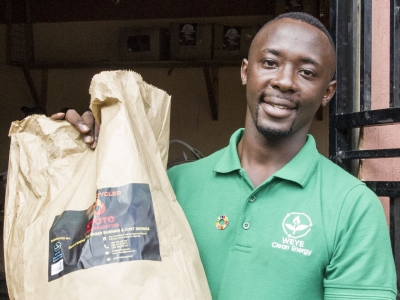
Brian Galabuzi of WEYE Clean Energy with a bag of briquettes, created from waste. (Image: Solomon Musisi/ African Revival.)
The Namugongo community residents had been trained to use plastic waste and turn it into useful and artistic products, becoming successful in their own right and at the same time, earning sustainable incomes.
Today, not only the Namugongo region with its history of bloodshed is fast becoming an icon of eco-friendly businesses, managing environmental plans and processes and using natural resources. The director of the St Kizito High School, Frederick Kakembo, with his vast experience in community upliftment, put it aptly, “I believe that you must first use what you have before you look elsewhere.”