Alex Rose-Innes
When discussing innovations which changed the world, very few would be able to hold a candle to the Great Green Wall, a unique enterprise addressing one of the planet Earth’s biggest challenges of the 12st century, desertification.
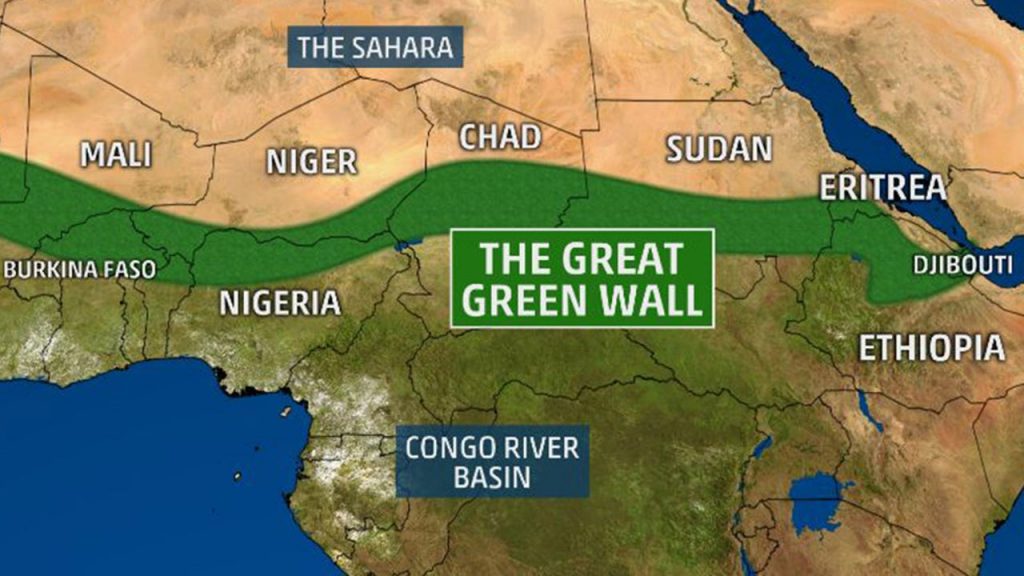
This 8 000km natural wonder is the largest man-made living structure on the planet and with only 4% completed at the end of 2020, it had already transformed the African landscape and the lives of millions of poor people on the continent.
The African Union launched the project thirteen years ago and it had been a game changer. It had already been implemented in over 20 countries in Africa which faced a continual encroaching desert and loss of agricultural land and would at finalisation, create millions of sustainable green jobs, save degraded land and turn 250 million tons of carbon dioxide into clean air for Africa’s growing population.
Under the leadership of the African Union Commission and Pan-African Agency, eight billion dollars were needed to implement this initiative which saw international partners working together with various African governments to stop the arid Sahara desert from encroaching further into the continent.
The United Nations (UN) estimated that it would, within another eight years, restore 100 million hectares of currently unusable land and support many communities living along its borders. By 2030, humanity’s most precious natural asset, fertile land, would provide additional opportunities for the next generation, drive food security and address climate change across the region which sees some of the highest temperatures on the planet.
Especially the depleted Sahelian lands had been restored and in Ethiopia land tenure security had improved with the addition of 15 million arable lands. Across Senegal almost 12 million trees had been planted and 25 000 hectares of degraded land restored. Sudan had so far seen 2 000 hectares of land restored with 120 communities in Niger, Mali and Burkina Faso, the green belt had seen dry lands renewed and millions of seeds from fifty endemic species of trees planted.
The UN’s Fleuve project, a local environmental coalition for a greener environment, had implemented this flagship drive which had been financed by the European Commission for the last six years. It strengthened local community capacity to assist in boosting investments towards land restoration projects and the creation of sustainable jobs. The local people bought into the project and had been driving it since inception.
Micro-investment projects were implemented under FLEUVE in 23 communities across five Sahel countries – Burkina Faso, Chad, Mali, Niger and Senegal. The Sahel is the eco-climatic and biogeographic realm of transition in Africa between the Sahara to the north and the Sudanian savannah to the south. Having a semi-arid climate, it stretches across the south-central latitudes of Northern Africa between the Atlantic Ocean and the Red Sea. Regional-level capacity building activities included education of populations regarding good sustainable land management practices and saw innovative financing options, driving the success of the Green Wall Project even further.
The Global Mechanism of the UNCCD is also supporting the development of sustainable value chains, working with the private sector to guarantee purchases of dry land products from the Sahel. This had led to the creation of land-based jobs for thousands of rural women in the region. The Irish Government had donated a further more than one million Euro to support the project. A portfolio of transformative projects along the Green Wall had also been established to ensure future funding.
A massive public awareness campaign on the Green Wall, called “Growing a World Wonder,” had been launched by the UN which aims to boost global awareness of the initiative to inspire a global movement to support this ground-breaking project by 2030.
In a statement to global media across various public spheres, the UN had focused on the core fact that the Green Wall is an urgent symbol of hope in the face of the greatest challenges faced by mankind this century such as climate change, food security, migration and resource-driven conflict. It is considered a compelling example of man and nature working together to create a unique legacy, a new world wonder for the next generation.
The campaign had already reached millions of people through mass media, virtual reality, high-level events and civil society involvement. Among the future highlights is the release of the Great Green Wall documentary produced in collaboration with an Oscar-nominated filmmaker, Fernando Meirelles.
Permanent and long-term partners include the European Union, the Food and Agriculture Organisation of the United Nations, the UN International Union for Conservation of Nature and the World Bank to name but a few. A permanent Inter-State Committee tasked with drought control in the Sahel had also been established.