Cape Town-based Kraaifontein Wastewater Treatment Works will host the first floating solar plant. The University of Cape Town (UCT)’s department of electrical engineering will monitor the data of the solar panels punted as a new generation in energy generation.
The initiative is a partnership involving the City of Cape Town, the Water Research Commission, Floating Solar (Pty) Ltd and UCT. Peter Varndell, of Floating Solar which provided the equipment and developed the project, said the solar plant has been developed using Cape Town’s infrastructure.

Significant benefits
Varndell said: “This allows the city the opportunity to better understand the technology and its potential application across other sites as part of its drive towards renewable energy.” He said the system has immense benefits such as reducing evaporation from water bodies, while sparing limited land expanses for other use.
He said they have been involved in floating solar for a few years now and as part of catalysing the market, they “realised the importance of having factual information around the evaporation-savings potential and the improved performance of floating solar over land-based solar”. He added that “this is key in defining the value and investment case for this unique solution. We will run this experiment for 12 months, while continuing with other projects across Southern Africa”.
Impartial evaluation
Richard Larmour, of the Advanced Machines and Energy Systems (AMES) group and the department of electrical engineering explained how the project came about. He said Floating Solar approached UCT to do an impartial assessment of the technology’s performance at the Kraaifontein pilot plant.
Larmour said his role will be to provide continual assessment of the project performance over a period of a year. The idea is to ensure that they include a full seasonal weather cycle. During this period, we will be reporting at contracted intervals, he added.
Photovoltaic panels
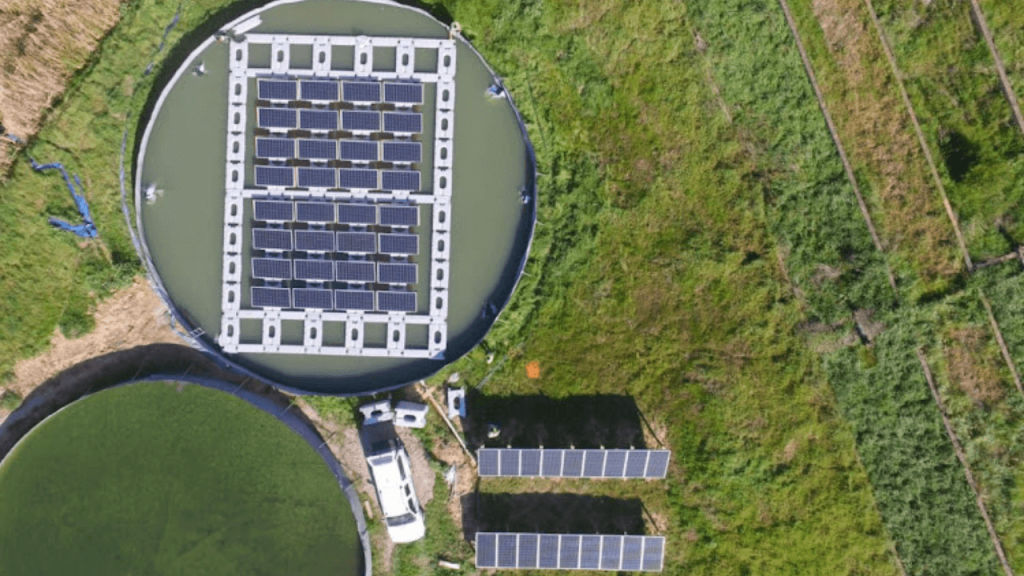
Varndell said the installation of the system took just under a month. It involves a basic floating system consisting of photovoltaic (PV) panels mounted on a floating solar island, two tanks and a three-phase inverter. Explained Varndell: “Hydrelio® technology consists of modular ‘Lego-type’ floaters, and installation is very straightforward and does not require any heavy tools – allowing for smooth and quick deployment.” Hydrelio® is the name of the patented floating solar system that allows standard PV panels to be installed on large bodies of water. Larmour said: “The PV modules are mounted on an anchored structure that floats on a body of water, rather than on the ground or on the rooftop of a building. The advantages lie in water savings, and in avoiding the use of arable land.”
Empirical evidence
Larmour added: “We know, somewhat intuitively, that the temperature of the solar modules in close proximity to the water surface should be cooler than if they were mounted on the ground; but it is difficult to model just how much cooler. This experiment will provide important empirical evidence of the actual temperature difference, which could be used to calibrate simulation models. In the same way, we will be able to accurately quantify the impact of the system on water evaporation as a function of real local weather conditions.”
Quantifying evaporation
Vandall said the data will allow them to quantify evaporation reduction with floating solar; and improvements in panel efficiency with floating solar due to [the] cooling effects of water, and [the] effects of panel angles.
“The Kraaifontein floating solar plant produces electricity at pilot scale only, and is designed for research purposes. Once the performance of this technology has been accurately ascertained, the city will be in a position to include it in strategic planning at scale on larger bodies of water,” said Larmour.
The city’s mayoral committee member for energy and climate change, councillor Phindile Maxiti, said the pilot project is a tangible example of how to build a sustainable future, and how the green economy can be harnessed for sustainable and inclusive economic recovery.