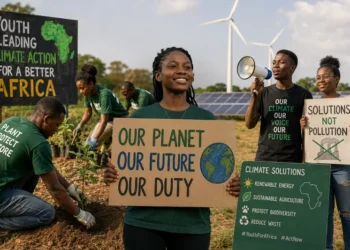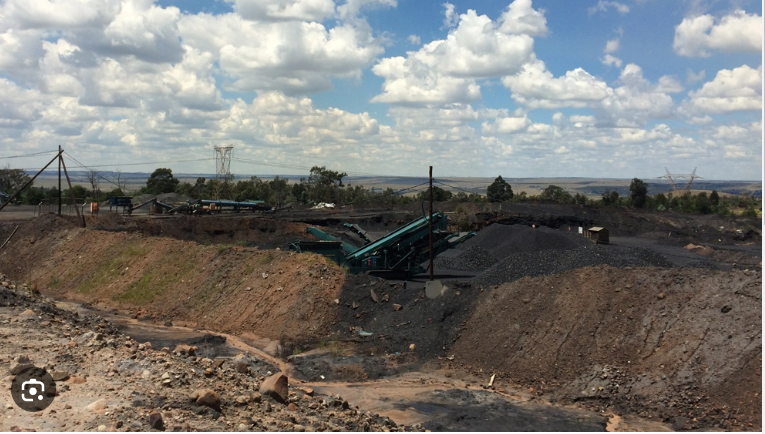
With the South African (SA) province of Mpumalanga the heartland of coal, people in the area are afraid they would lose their jobs and income if plans to Go Green, materialise.
Witbank, now called eMalahleni, (literally meaning place of coal), provides work at a plethora mines in the area where the environment is scarred with the damage already done to it.
While many young Africans are actively lobbying for a Green Future, a former SA politician is lobbying against the phasing out of coal mining in the area saying “it does not make economic sense to replace coal with renewable energy sources and that there is no realistic plan for how businesses are going to be assisted to combat unemployment.” What Pascaline Mazibuko (29) maybe does not understand is that if the environment is destroyed, where are people going to live and eat, let alone work?
Therein lays the problem which seems to be endemic in SA; of uninformed people who are allowed to be a very vocal presence at Just Energy Transition meetings with top level leaders of local and national government. Mazibuko had even started a foundation, “to build the economy of Mpumalanga,” which in her mind means, clinging to coal powered energy providers and destructive mining practises.
“We have been lobbying, and will continue to lobby, our people to say, ‘Reject this thing. It is not going to work for us,’” Mazibuko
The Oxpecker International Environmental Group, Africa’s first journalistic investigation unit focusing on environmental issues, has published an article on Mazibuko, in conjunction with journalist, Thabo Molelekwa.
In line with the country’s global commitments to reducing greenhouse gas emissions and moving to a lower-carbon economy, coal must be phased out and Eskom’s coal-fired power stations must be closed down, most of them by 2035.
According to Wikus Kruger, research lead and lecturer on power-sector investment in sub-Saharan Africa (SSA) at the Power Futures Lab at the University of Cape Town’s Graduate School of Business, SA has a long history of coal interests, which he calls the minerals-energy complex, a powerful grouping of decision-makers and business and political interests which had been around since apartheid.” He said although this grouping might have changed post-democracy, it’s still very much alive.
Over the years, research has focused on the minerals industries, in collaboration with the electricity monopoly, Eskom, to develop policy and practice in the mining, energy and financial sectors of the SA economy. Three years ago, Eskom aligned itself with a new political elite. However, “coal mining for electricity generation continue to dominate with far-reaching effects on the local and global environment, ” according to research published by Oxford University Press. It has also published a book on Ending Africa’s Energy Deficit and the Law: Achieving Sustainable Energy for All in Africa by Prof Yinka Omorogbe and Prof Ada Ordor.
Opposing Voices
The independent climate think-tank, InfluenceMap, released a report in February this year showing how industry lobbying is putting SA’s climate goals at risk. It found oppositional voices are significantly more engaged than pro-climate corporations on key policies such as the Climate Change Bill and the Carbon Tax Act, resulting in it being downplayed or delayed.
Based on an analysis of the policy engagement of 16 major companies and 12 industry associations, the report showed how the mining sector is the most opposed to supporting climate change advocacy and continues to strongly support the role of coal in the future energy mix. It focused on corporate engagement with key climate policies designed to help deliver on SA’s net zero by 2050 commitment and included Eskom, Sasol, the Minerals Council SA and Business Unity SA.
The report stated that despite nearly 75% of industry supporting renewable energy development in SA, certain sectors continue to strongly advocate for a continued role of coal and fossil gas, especially Anglo American, South32 and Exxaro Resources, once responsible for one of the biggest oil spills the world had ever seen.
Mary Stewart, an international climate risk and energy transition expert, told Oxpeckers that while coal lobbying can have a significant impact on policy and decision-making, “it is often insidious and works behind the scenes.” She further commented, saying; “They have deep pockets and employ a significant number of people, this always has great political sway. They are also typically members of the ‘old boys’ network,’ they know all the politicians, they have the same background, went to the same schools, they meet socially and not just for business.”
Stewart said this has a significant negative effect on the green energy sector: “Coal lobbying has the greatest impact on green energy investments by increasing uncertainty and thus reducing the appetite of investors to invest in green energy.”
Another problem, according to Kruger, is that the SA government is not speaking in a unified voice about how to deal with the energy crisis and how it is undermining confidence in the country’s energy sector. “There are a lot of policy confusion, contrasting statements from different people and a growing number of officials and politicians who seem to be responsible for this sector,” he said.
A Woke Solution
Mike Teke, chief executive officer of Seriti Resources, owner of six coal mines around eMalahleni supplies Eskom, as well as Seriti Green with the dark gold. Seriti Green is a subsidiary which announced in February this year that it was building a 155 megawatt wind farm, due to come online by 2025.
Teke outlined the transition of Seriti as a SA business operating in the energy space as a template for the future. “We started as a coal mining business. But the strategy we’ve adopted is to diversify into renewables and clean energy.
High-level Discussions
Teke says arguing about which energy source is better, is a waste of time. “We’ve accepted that coal is a fossil fuel and over a period of time, that transition will happen where we move from coal to renewables. But let’s do it in a responsible manner. Let’s not go into a community and say, ‘Tomorrow we’re shutting down this mine, we’re shutting down this coal-fired power station.’ What happens to this community?”
Amid continued load-shedding and high-level conversations about delaying the decommissioning of coal-fired power stations, the Presidency announced on 9 June that several criteria would need to be met for this to happen. According to Rudi Dicks, project management unit head for the government on Go Green, “the cabinet remained committed to SA’s decarbonisation targets.”
Dicks said any revision to the decommissioning schedule would be informed by a comparison of the costs of refurbishing older coal-fired power stations with the cost of investing in replacement capacity, including renewables, batteries and gas. Suggestions of extending existing coal-fired power plants’ lives, as well as building new ones, are being pushed by government factions, specifically in the Department of Mineral Resources and Energy, with a strong interest in coal.
Professor Brett Cohen, climate and energy consultant at the Department of Chemistry at the University of Cape Town said; “The bulk of the pro lobby is within Mpumalanga; it is people who are concerned about job losses and economic impact. There hasn’t been a clear policy signal from the government for renewables, that’s why it has been difficult to invest in renewables in SA.”
Training Opportunities
To reach the goals of the Paris Agreement, countries are called upon to mobilise and help one another to provide financial resources and technologies, particularly to support developing nations and countries more vulnerable to the effects of climate change.
According to the Renewable Energy Institute, which had been promoting best practice in renewable energy since 1975, it also works to promote best practice and knowledge-sharing in renewable energy and energy efficiency topics and by working with the United Nations (UNEP) and leading universities across the globe, offers a range of educational opportunities and professional training courses. In SA, this can be done at the Cape Peninsula University of Technology.
What happens if SA does not Meet Renewable Energy Targets?
If by 2030, countries who did not meet the targets, will facing up to 2.7 degrees Celsius in global warming that will lead to more extreme weather systems, with large flooding, forest fires and droughts, all of which can impact both communities and wildlife.
Wild animals will need to adapt to face new and challenging environments and may alter the reproduction rates of certain species, causing a knock-on effect in that particular food chain and resulting in further loss of life.
Rising temperatures will significantly affect the seas. Coral reefs today have taken severe damage from their environments, but in future, if temperatures do continue to rise, many reefs will not be able to survive at all. Rising sea levels caused by the melting of ice caps lead to beach erosion and flooding and sea level rises would wreak havoc on coastal habitats.
With an increase in extreme weather systems, communities around the world will suffer. Bursts of heavy rain will cause flash flooding whilst extreme heat can cause droughts. The UN now estimates that one in four children will be living in an area with extreme water shortages by 2040, greatly affecting not only access to drinking water, but also adversely affecting industry, agriculture and health. In the UK, the Met Office projects that by 2070, winters will be up to 30% wetter, causing more localised and coastline flooding that will damage homes and businesses.
The climate emergency presents a variety of health challenges and risks primarily due to air pollution. The UN estimates that one million lives a year will be lost due to in air pollution. This is not only a health issue, but an economic one with billions already spent on health and economic costs as a result of air pollution.
The Paris Agreement, a legal and globally binding agreement, sets out specific targets with a purpose – to ensure that the effects detailed in this article are at worst reduced, and at best halted entirely. However, without work from governments, businesses and individuals, the Paris climate targets will not be met and the climate emergency will accelerate. And Ms Mazibuko will have had a serious wake-up, but sadly, it will be too late.