
Impacts on health, economy and human capital
Alex Rose-Innes
According to African and other global scientists, Africa is undergoing an environmental and epidemiological transition. Household air pollution is the predominant form of air pollution, but it is declining, whereas ambient air pollution is increasing. The study (*see list of authors at end of article) aimed to quantify how air pollution is affecting health, human capital and the economy across the continent with a particular focus on Ethiopia, Ghana, and Rwanda.
The situation in Africa
Data from the 2019 Global Burden of Disease Study shows that air pollution is now the second largest cause of death in Africa. It is responsible for more deaths than tobacco, alcohol, road accidents and drug abuse, with only AIDS causing more deaths.
Lower respiratory infections accounted for almost 340 000 deaths during 2019, with heart disease, neonatal disorders, chronic obstructive pulmonary disease and strokes, leading causes of fatalities in these three countries. Patterns of air pollution-related disease and death vary across Africa. The highest rates were noted in countries with the lowest social development indices.
Data on household and ambient air pollution were obtained from the World Health Organisation’s (WHO) Global Health Observatory. This study, published last year, incorporated estimated economic output loss due to air pollution-related disease by country, using income per worker, adjusted by the probability that a person (of a given age) was working. Losses were expressed in 2019 international dollars and as a proportion of gross domestic product (GDP).
The authors also quantified the contribution of particulate matter (PM) pollution to intelligence quotient (IQ) loss in children younger than 10 years, with use of an exposure–response based on previously published data.
What is particulate matter (PM) in air pollution?
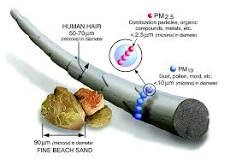
PM is also called particle pollution – the term for a mixture of solid particles and liquid droplets found in the air. Some particles, such as dust, dirt, soot, or smoke are large or dark enough to be seen with the naked eye
Findings of the study
Air pollution was responsible for 1.1 million deaths across Africa in 2019. Household air pollution accounted for 697 000 deaths and ambient air pollution for 394 000. Ambient air pollution-related deaths increased from 361 000 in 2015 to 383 000 in 2019 with the greatest increases across the most developed countries on the continent.
The majority of deaths due to ambient air pollution are caused by non-communicable diseases. The loss in economic output in 2019, due to air pollution-related morbidity and mortality, was $3·02 billion in Ethiopia (1.16% of GDP), $1.63 billion in Ghana (0.95% of GDP) and $349 million in Rwanda (1.19% of GDP). PM pollution was estimated to be responsible for 1.96 billion lost IQ points in African children in 2019.
Ambient air pollution is increasing across Africa. In the absence of deliberate intervention, it will increase morbidity and mortality, diminish economic productivity, impair human capital formation, and undercut development.
Because most African countries are still early in development, this provides unique opportunities to transition rapidly to wind and solar energy, avoiding a reliance on fossil fuel-based economies and minimising pollution.
African population growth and urbanisation
Africa’s population, currently the world’s youngest, with average age of 19.7 years, is projected to more than triple this century, from 1.3 billion to 4.3 billion.
The continent is urbanising with many moving to cities to find jobs and is projected to have 13 megacities by 2100. African countries are advancing economically, industrialising and building infrastructure as never before.
However, this leads to increased environmental risks from traditional to modern sources of pollution. Household air pollution is still the predominant form of air pollution, but is declining, whereas ambient air pollution is increasing. At the same time, Africa is passing through a massive epidemiological transition from communicable to non-communicable diseases.
This study focused on the economic development of three sub-Saharan African countries, Ethiopia, Rwanda and Ghana.
Ethiopia
From 1958 to 1973, Ethiopia sought to boost its economy by producing consumer goods for the domestic market, attracting foreign investors and expanding the manufacturing sector.
In the mid-1980’s, after the revolution, Ethiopia attempted to shift economic priorities away from agriculture towards import substitution and labour-intensive industries.
In 2002, Ethiopia created the Industrial Development Strategy, focused on eradication of poverty and sustainable development. This placed emphasis on enhancing exports and linkages to international markets to foster internal economic growth.
Ghana
In 1965, 8 years after gaining independence, Ghana embarked on a broad, long-term strategy to move the country from low-income to middle-income status by the year 2020.
The country was able to halt and reverse the downward trajectory of its economy and repair upscale infrastructure by reshaping its industrial structure, decreasing reliance on imports and focusing on import substitution. Additional priorities included poverty reduction, protecting the vulnerable and achieving financial growth. Through these actions, Ghana has grown its Gross Domestic Product (GDP) at an average annual rate of 11.2% and had successfully moved from low-income to lower-middle-income status.
Rwanda
President Paul Kagame and his government created Vision 2020. This 20-year plan is focused on transforming Rwanda from a primarily agrarian economy into a middle-income, technology-led, data-based economy.
Vision 2020’s goals are reducing poverty, overcoming division and improving health care. To facilitate economic growth, Rwanda focused on developing human resources, the private sector and infrastructure. Additionally, the country is moving toward producing high-value, market-oriented agriculture and focusing on regional and international integration.
Positives and negative outcomes
Reflecting the epidemiological transition, life expectancy across Africa had almost doubled, from 36.5 years in 1950 to 64.1 years today. Infant mortality had dropped by approximately 70%, from 187 deaths per 1000 live-births in 1950 to 51 per 1000 in 2019.
Deaths from communicable diseases decreased by 95% despite the continuing burden of AIDS, malaria and tuberculosis (TB). During the same period, deaths from non-communicable diseases increased in number from 2.1 million to 3·8 million.
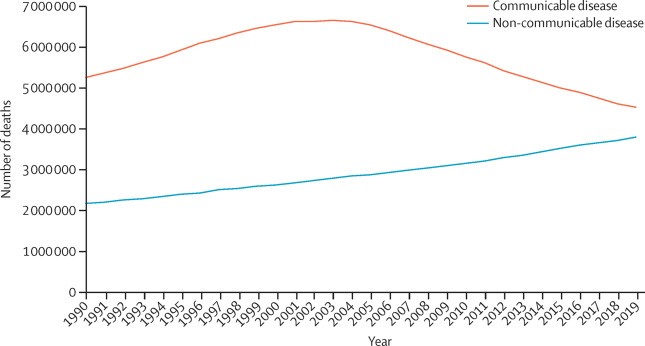
This graph from the study shows figures attributable to communicable and non-communicable diseases in Africa from 1990 to 2019.
Scientists say there is an urgent need to understand how environmental risk transition is shaping the epidemiological transition in Africa and specifically how changing patterns of pollution are driving the rise of non-communicable disease and affecting economic development.
Africa’s Africa’s population growth
The continent’s population is on track to more than triple this century. Cities are expanding exponentially, economies are growing and life expectancy has almost doubled.
However, at the same time, ambient air pollution is increasing as a consequence of increased fossil fuel combustion and ambient air pollution-related mortality has risen from 26·13 per 100 000 population in 1990, to 29·15 per 100 000 in 2019. Although this increase is considered modest, it is historically unprecedented.
The greatest increases are in the most highly developed African countries. Until this study, the impact of ambient air pollution on the economies and human capital of African countries had not previously been assessed. This information gap blinds development planning as it impedes full consideration of threats and opportunities of the various development pathways.
The far-reaching effects of ambient pollution across Africa
The authors of this study estimated that annual productivity losses resulting from ambient air pollution-related disease and premature deaths at $3.0 billion in 2019 in Ethiopia, 0.95% of Ghanaian GDP and $349 million in Rwanda. Particulate matter pollution (PM) was responsible for 1.96 billion lost intelligence quotient points in African children.
Air pollution exposure during sensitive periods of brain development in pregnancy and early childhood can cause brain injury in children, reducing cognitive function as measured by IQ score and impedes formation of human capital.
The present value of lost labour output depends on the rate at which output grows and on the rate at which it is discounted to the present. The scientific expert authors of this study used underlying assumptions of the Lancet Commission publication on pollution and health.
Final Study Results
Household air pollution is the dominant form of air pollution across most of Africa, but declining slowly and unevenly. Ambient air pollution, by contrast, is increasing. Sources of ambient air pollution include electricity generation, industrial emissions, vehicular exhausts, wind-blown dust and crop burning.
Many African countries have higher pollution concentrations exceeding the WHO guidelines. In all three countries, Ghana, Ethiopia and Rwanda, air pollution concentrations were considerably higher than considered healthy.
In 2019, an estimated more than one million deaths, attributable to air pollution occurred across Africa with the highest fatalities recorded being household air pollution, followed by ambient PM and ozone pollution.
Air pollution is now the second largest cause of death in Africa, responsible for more deaths than tobacco, alcohol, road accidents and drug abuse. Only AIDS causes more deaths. Deaths attributable to air pollution result from lower respiratory infections, ischaemic heart disease, neonatal disorders, chronic obstructive pulmonary and stroke. Patterns of air pollution-related disease and death vary across Africa. The highest rates are seen in countries with the lowest social development indices.
An upward trend in ambient air pollution-related mortality is especially evident in Ghana, the most economically advanced of the three countries examined in the study and starting to emerge in Ethiopia and Rwanda with 43% of ambient air pollution-related deaths and 47% of household air pollution-related deaths, occurring among women.
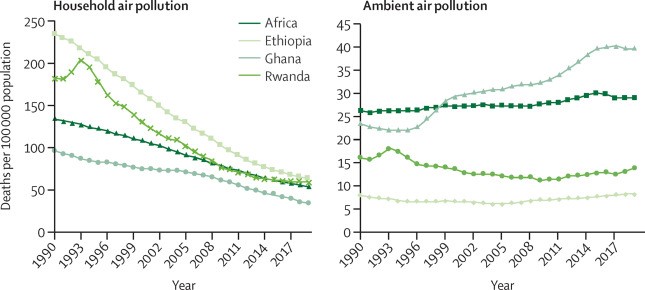
This graph shows deaths attributable to household air pollution and PM air pollution in Ethiopia, Ghana, Rwanda and across in Africa from 1990–2019
In the three countries which were the focus of this analysis, household air pollution exposures were highest in Ethiopia and Rwanda, where an estimated 98% of households burn solid fuels for cooking and heating. In Ghana, only 84% of households burn solid fuels and the household air pollution-associated PM, much lower.
Ambient air pollution exposures show the exact opposite pattern and continued to rise across all three countries and Africa overall. Patterns of morbidity and mortality reflect these gradients. In Ethiopia and Rwanda, the number of deaths and the fraction of disability-adjusted life-years attributable to household air pollution are three to four times higher than those associated with ambient air pollution. The predominance of household air pollution exposures in all three countries reflects their relatively early stages of economic development.
The loss in output due to air pollution-related diseases was around $318 million in Ethiopia, $249 million in Ghana and $41 million in Rwanda three years ago. These losses are 0.12% of GDP in Ethiopia, 0.15% in Ghana and 0·14% in Rwanda.
The combined output losses due to air pollution-related morbidity and mortality in these three countries are substantial: more than $3 billion in Ethiopia, $1·63 billion in Ghana and $349 million in Rwanda.
However, thanks to sustained interventions by governments, non-governmental organisations, and United Nation organisations, disease and death from household air pollution are now declining, albeit slowly and unevenly.
Experience from other countries suggests that the increases in ambient air pollution in Africa today could be the leading edge of a looming problem. In the absence of visionary leadership and intentional intervention, ambient air pollution could become a much larger cause of disease and premature death than at present and could pose a major threat to economic development.
Analyses showed that air pollution already has large negative impacts on the economies of African countries and suggests that, in the absence of deliberate intervention, these impacts could become still greater in the near-term. Air pollution impedes the formation of new human capital in African countries and undermines prospects for future development by causing brain injury to young children that, in turn, diminishes cognitive function and reduces IQ.
On the positive side, African countries are well positioned to avoid ambient air pollution. With a few exceptions, most notably Nigeria, African countries are not yet deeply invested in fossil fuel-based infrastructure. They therefore have a unique opportunity to advance their societies by investing in renewable energy and non-polluting technologies and leapfrog heavy reliance on oil and natural gas.
With wise choices, African countries can develop sustainably and achieve prosperity, while avoiding ambient air pollution, related disease and death which have plagued development in those countries relying on coal, oil and gas to power their economic growth.
New studies are likely to reveal additional links between air pollution and disease, thus increasing future estimates of the disease burden attributable to air pollution.
Recommendations
- Transition to clean, renewable sources of energy
- Make air pollution prevention and control a top priority in all countries
- Allocate sustainable, long-term funding for air pollution control
- Reduce household air pollution
- Conduct source apportionment studies to identify and quantify the most important sources of air pollution
- Track patterns and trends in air pollution by establishing robust monitoring systems and increase public education campaigns
- Advance air pollution control through public education campaigns
- Champion air pollution control through the establishment of multi-sectoral partnerships and
- Promote research and build research capacity on air pollution, human health and the economy in African research institutions
Authors
Samantha Fisher, MPH
Prof David C Bellinger, PhD
Prof Maureen L Cropper, PhD
Pushpam Kumar, PhD
Prof Agnes Binagwaho, MD
Juliette Biao Koudenoukpo, PhD
Authors and analysis supported by the United Nations Environment Programme.