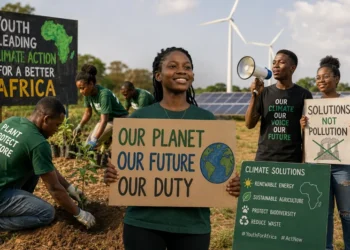


Women living in rural areas in Africa’s Sahel region and across the world are disproportionately affected by the climate crisis and yet they are traditionally excluded from decision-making, both at the community level and internationally. But women play a crucial role in protecting and restoring ecosystems.
Greening Afrika, in this Women’s Month, honour and celebrate their achievements, for not only addressing the climate crisis, but have made huge impacts in fighting gender inequality and the effects of the climate crisis across the continent.
The late Professor Wangari Maathai set the scene for African women to shine and make a difference. As Greening Afrika had previously featured this phenomenal woman, we shall honour her legacy by shining her magnificent light on those following in her footsteps.

A Kenyan scientist and environmentalist, Dr Chomba is director of Vital Landscapes for Africa at the World Resources Institute, leading their work on forests, food systems and people, which includes forest landscape restoration, sustainable agriculture and food systems and thriving rural livelihoods in Africa.
Susan has over 15 years of research and development experience in Africa and has been instrumental in setting the agenda for landscape restoration through local, national and global platforms. Susan works with smallholder farmers, particularly women and youth, to help them make the most of their land.
Speaking at the GLF Climate Conference in 2021, she expressed the importance of collaboration when it comes to land restoration across Africa: “It is about using scientific evidence to assess the extent of land degradation and providing that kind of knowledge, together with local indigenous knowledge to come up with the right restoration methods. The thing I’d like to see about land restoration is working across partnerships – working with regional governments, local governments, private sector actors, communities, working with women, youth groups and other indigenous groups that may be stakeholders in different contexts that we are restoring. That is going to be critical. Having inclusive restoration processes is very, very possible.” Find out more about Susan’s work at the World Resources Institute.

Inna Modja
Inna Modja is a Malian-French artist, singer-songwriter, actress and activist for women’s rights and climate change. In 2019, she became an UNCCD Land Ambassador for the Sahel and against desertification. Inna appeared in and wrote the music for, the UNCCD’s 2019 Great Green Wall documentary. The acclaimed film followed her extraordinary journey through Senegal, Mali, Nigeria, Niger and Ethiopia.
Speaking on the Creative Development podcast last year, Inna said, “I grew up in the Sahel and as a woman I wanted to show what the Sahel is going through; the beauties and the challenges and the hope and resilience of the people that I met along the Great Green Wall. I wanted to share their stories. So I started travelling in 2017 to rural areas in different countries, to spend time with the communities and understand.”
With a strong following in Francophone West Africa and France, Inna is a leader among the young people committed to changing the narrative of the Sahel.
“Women are truly the backbone of the Great Green Wall. In the communities, women are leading the projects. For climate solutions all around the world, women are a big part of it,” Inna Chomba at COP.
“I’ve seen amazing inspiring women doing work that is going to transform their communities, starting with their families, their communities, their country, the continent. In French we say “le noyeaux” [the core]. They are the heart of the communities.” Follow Inna’s journey on Instagram.

Vanessa Nakate
Vanessa Nakate is a Ugandan climate justice activist. She began advocating for climate justice in 2019 with a protest on the streets of Kampala, inspired by Greta Thunberg. She continued to protest every week, becoming a well-known face in a global movement of young people striking for the climate.
Vanessa rose to further prominence when she was cropped out of a news photo in which she appeared alongside Thunberg and other white climate activists. Her response that the news outlet “didn’t just erase a photo, you erased a continent,” made international headlines.
In 2022 she became a UNICEF Goodwill Ambassador. “As a young African woman, I have had to fight to be heard by the media and decision makers,” she said. “While I am fortunate to have a platform now, I intend to continue fighting for others. The children on the frontlines of the climate crisis, like those I just met in Turkana, Kenya, are the people for whom I will fight in my new role with UNICEF.”
Vanessa has since used her platform to advocate for climate justice to include every community, especially those from the most affected places. She founded Rise Up Movement, a platform to elevate the voices of African climate activists, as well as a project to install solar panels in rural Ugandan schools. She has addressed world leaders at a number of COP summits and appeared on the cover of TIME magazine. Follow Vanessa’s work on LinkedIn.

Oureratou is an environmental economist from Burkina Faso with extensive knowledge and experience in gender-related issues and climate change. She is also the national coordinator for Burkina Faso for the Pan African Climate Justice Alliance (PACJA) and president of ANGEL_SD (African Network on Gender Equality and Sustainable Development). She specialises in development issues, sustainability and gender mainstreaming in development policies and programmes.
She leads the African Activists for Climate Justice programme at PACJA in Burkina Faso, which aims to amplify and unite the voices in Africa demanding that the most vulnerable groups, women, youth and local indigenous communities have the capacity to defend and realise their human rights and live a decent and dignified life in a healthy and sustainable environment within the context of the climate emergency.
“Strengthening African women’s access to climate finance is a guarantee of the resilience of African communities in the face of climate change. There can be no climate justice without addressing the impact of climate change on African women as they remain the most impacted by the climate crisis. To liberate women is to liberate humanity” Oureratou Ouedraogo

Hindou Oumarou Ibrahim
Hindou Oumarou Ibrahim is an expert in the adaptation and mitigation of indigenous peoples to climate change. She is a member of the Mbororo pastoralist people in Chad.
Hindou began advocating for Indigenous rights and environmental protection at age 16, founding the Association for Indigenous Women and Peoples of Chad (AFPAT), calling for the greater inclusion of indigenous people, their knowledge and traditions in the global movement to fight the effects of climate change. She is also Chair of the United Nations Permanent Forum on Indigenous Issues.
“In my community, women are the ones who know where you can find traditional medicine; the plants that can reduce fever or stop diarrhoea, they can find the food that feeds families,” she wrote in an article in The Skylark. “They have knowledge that is useful for an entire community.”
“So, to protect these women from climate impacts and recognise their value, they also need to be included in discussions on climate change from the beginning. And it’s not about achieving a quota, making sure that if there are ten participants, at least three of five are women. It is about genuinely wanting to consider what women have to say, giving women the right to express their voices and show themselves as experts who can take the decisions.
“Let women take the lead and see the progress that can be made in averting catastrophic climate change. You see this in countries where there are female leaders; their climate change policies are better respected than where there is male leadership.” Follow Hindou’s work on LinkedIn.

Dr Eliane Ubalijoro
Dr Éliane Ubalijoro is the CEO of the Centre for International Forestry Research and World Agroforestry (CIFOR-ICRAF) and a prominent Rwandan-Canadian scholar, researcher and leader in sustainable development, innovation and global governance.
As a strong advocate for “leadership for good,” Dr Ubalijoro emphasises the importance of ethical and inclusive leadership in driving positive social change and sustainable development initiatives. She started her career in the biotechnology sector working in molecular diagnostics, later pivoting to focus on improving the lives of women and smallholder farmers in Africa and other emerging countries.
She often cites Wangari Maathai, the renowned Kenyan environmentalist and Nobel Peace Prize laureate, as her hero and inspiration for her pioneering work in environmental conservation, women’s empowerment, and grassroots activism. As the first African woman CEO of CIFOR-ICRAF, she reflected on what the role means to her in an interview with the Global Landscapes Forum (GLF) in 2023:
“I feel very privileged. For me, it’s really about how do I continue the legacy of my mother, who taught me my first lessons around sustainability, around living in harmony with nature? How do I continue to build on the legacy of what Wangari Maathai has brought to Kenya? How do I continue on the legacy of all the people who are working tirelessly to grow seedlings, to nurture them, to plant them on the ground, whether you’re at the Great Green Wall or you’re in South Africa – how do we look at the whole continent?
“And how do we look at the critical importance of female smallholder farmers, because we know that most of the smallholder farmers on the continent are women. So how we support them in terms of building prosperity, of having sustainable enterprises for being able to feed their families and to contribute to their communities in terms of building social capital is very critical.”